
Proflex Market Update — Week July 27-31, 2026
The Leverage Purge | Capex Accelerates | 30 Year at a 2007 High | Jobs Week
Markets comes back this week after one of the most violent stretches it has produced in years. What makes it unusual is where it happened.
Look at the S&P and you would conclude nothing occurred. The index sits at 7,571, up about 2% on the week, with the VIX back to 16. That is a calm tape. The action was entirely underneath it, in semiconductors and the AI complex, where SMH fell 17.6% in a single month and sits roughly 19.6% below its high.
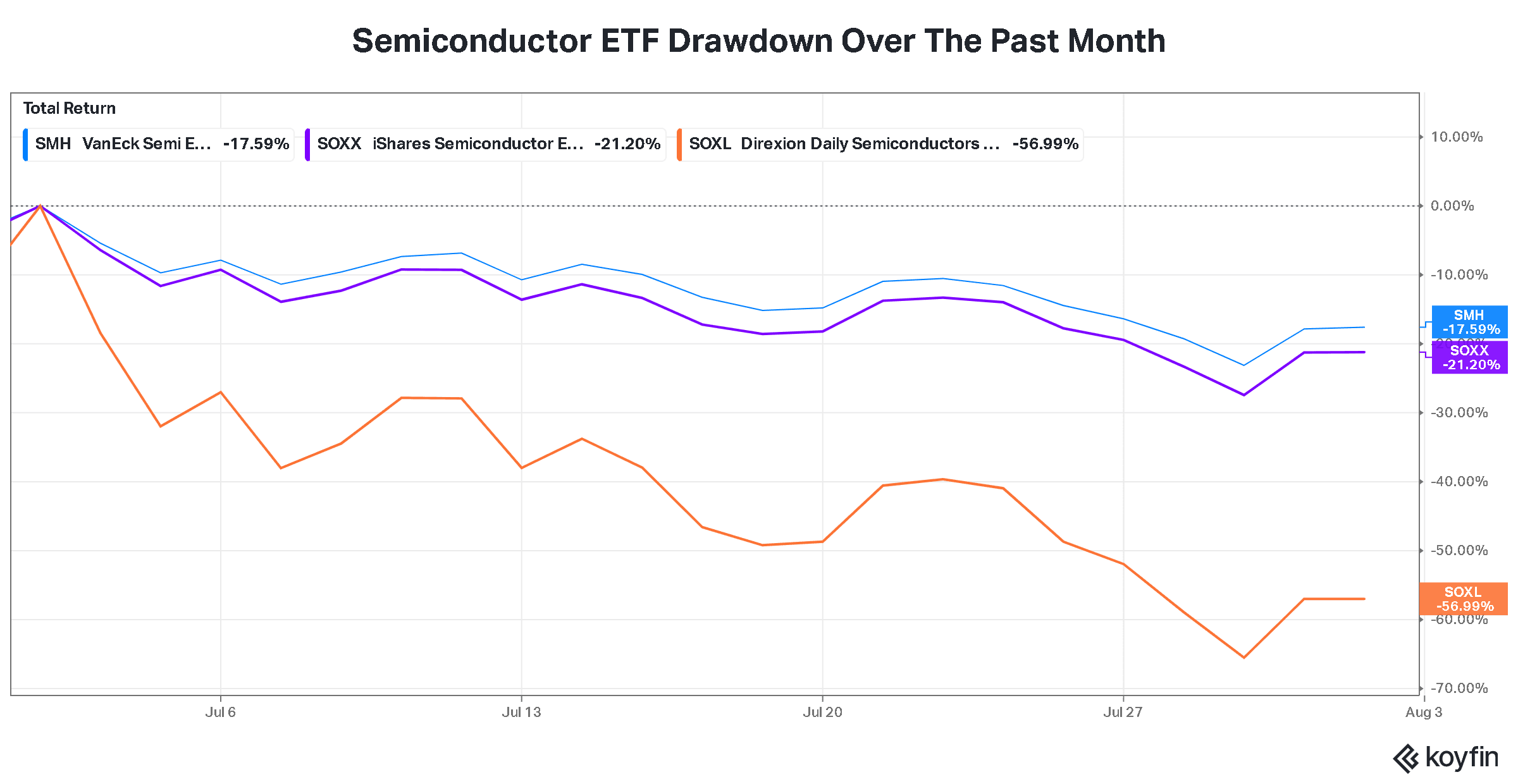 Micron is down 28.7% in a month, from a 52 week high of $1,255 to $800 levels. Apple lost 7.4% in one session on memory costs. Roughly $1.3 trillion came off twenty major chip names. None of that was caused by a change in the fundamentals. It was caused by leverage being removed from the system, in two places, in the same week. We flagged this exact mechanism in June and again in July, when we called Korea's circuit breakers "the single most under covered risk in global markets" and wrote that the fragility "eventually gets exported." It got exported. Proflex All-Access Gain Complete Access to our full research suite, curated from over 50+ analyst forums, Real-time Trade Alerts & Updates for Growth & Income Opportunities —and join a thriving investor community alongside Big Tech Executives and fund managers from Silicon Valley and beyond.
|
 |
Almost all of the concentrated money went into sectors, and specifically into AI and semiconductors. Set that against a single fund carrying $45bn at four times leverage and you understand why one liquidation moves a $5 trillion company. The marginal buyer is not large. The marginal levered seller is.
Three further points from the call worth carrying into the week:
- Stop losses do not work in this regime. When the range on a mega cap widens to 20% inside a week, a technical exit level is simply the price at which you get taken out before the recovery. Conviction and position size are the only usable controls left.
- The deleveraging is cleansing, not curative. Excess got flushed and that is genuinely healthy. But the funds that survived did not learn anything. They will lever back into the same trade, because the AI euphoria that justified the leverage has not changed.
- Price is set by money flow, not fundamentals. That is the reason gold trades below its 200 day average while central banks buy record tonnage. Nothing about gold's demand broke. The money simply left to fund something else.
You can watch the complete recording here:
Key Drivers This Week
The Leverage Purge: One Fund, One Country, One Week
The specifics matter here, because the scale explains the price action better than any narrative about AI doubts.
Situational Awareness, Leopold Aschenbrenner's AI infrastructure fund, ran $45bn at peak and was up 439% year to date through June.
It carried roughly four times leverage on core positions in SK Hynix, Micron, Nebius and CoreWeave.
 |
July took the fund down 67%. Prime brokers issued the calls, the book was sold to Citadel on July 30, and assets finished near $10bn.
Korea was the second engine. Single stock leveraged ETFs only launched there on May 27, and Korean retail put 14 trillion won into them inside two months.
The KODEX SK Hynix leverage product is down about 70% from its June high. Roughly 1.2 million accounts hit margin calls, 320,000 to 360,000 were forcibly liquidated, and the exchange tripped four circuit breakers in 22 trading days.
On August 1 the FSC raised the minimum cash margin tenfold to 30 million won, lifted the minimum lot to 20 units, suspended new listings and banned advertising.
The US had its own accelerant. FINRA margin debt hit a record $1.53 trillion in June, up 7.9% in a month and roughly 50% on the year, and the shift to intraday margin calculation removed the buffer that used to let accounts recover before the close.
Then it stopped. The Philadelphia semiconductor index rallied more than 7% on Thursday. JPMorgan's read was that the deleveraging "has happened more quickly than anticipated" with limited room for more.
The Check Writers Doubled Down
While the market was busy deciding AI had gone too far, the four companies funding it told the opposite story in the same fortnight.
Get This Analysis Every Week
Join 250+ investors at Google, Amazon & Apple who start their week with Proflex.
No spam. Unsubscribe anytime.
Alphabet spent $44.9bn on capex in the quarter and raised full year guidance to $195bn to $205bn. Amazon spent $53.1bn and raised to $220bn.
Meta spent $31.1bn and lifted the low end of its range. Combined 2026 hyperscaler capex now runs near $725bn, up 77% year on year.
The backlogs are the reason they can do it. AWS contracted commitments jumped from $364bn to $496bn in one quarter. Google Cloud's remaining performance obligations sit at $514bn against a $99bn annualized run rate.
 |
Andy Jassy said the lion's share of 2027 capacity is already reserved and that Amazon "won't have enough capacity to meet all the demand" in 2026 or 2027. Sundar Pichai's CFO called it plainly supply constrained.
The bill is now visible.
Alphabet posted negative free cash flow of $5.9bn, the first in its history as a public company.
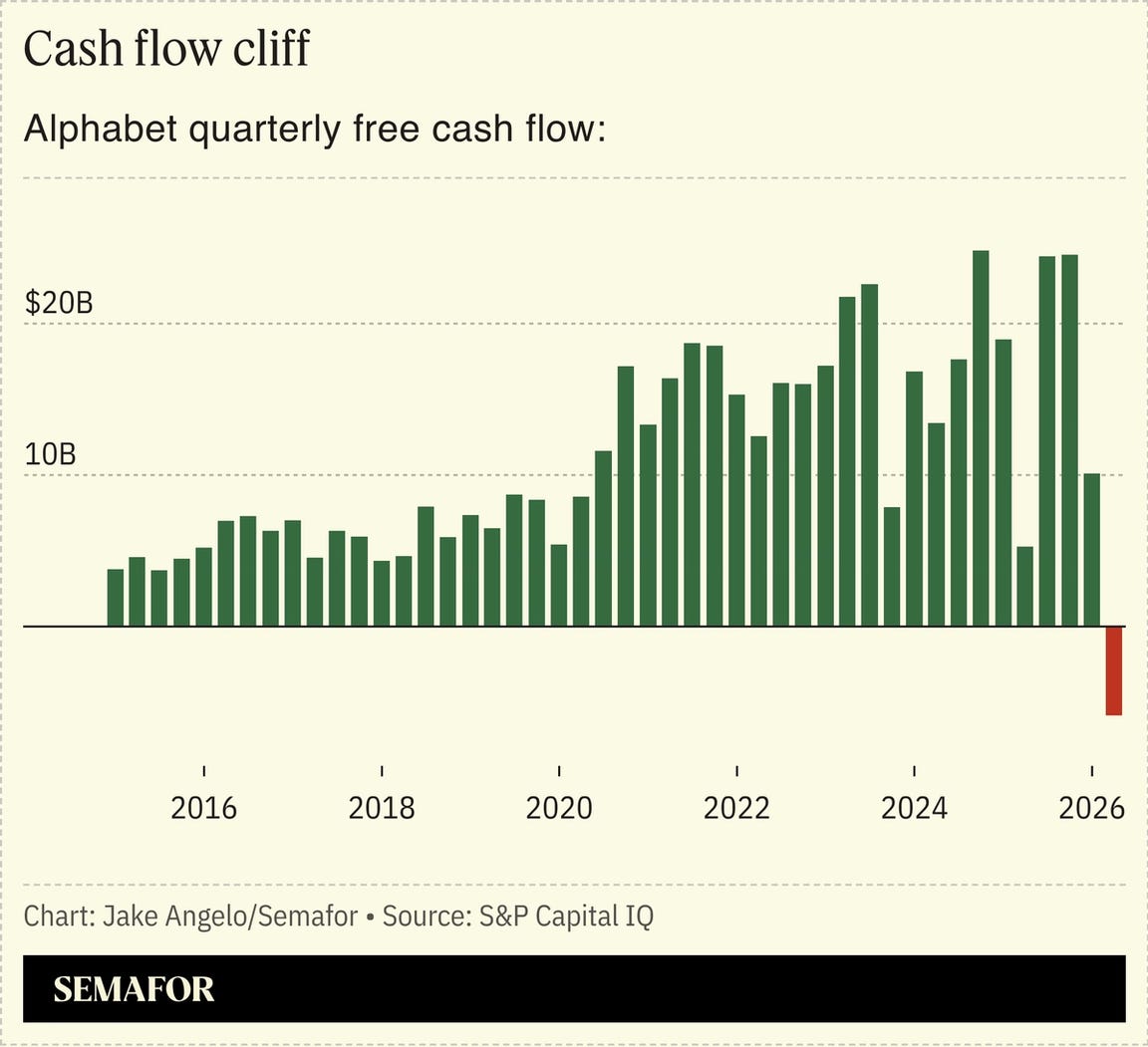 |
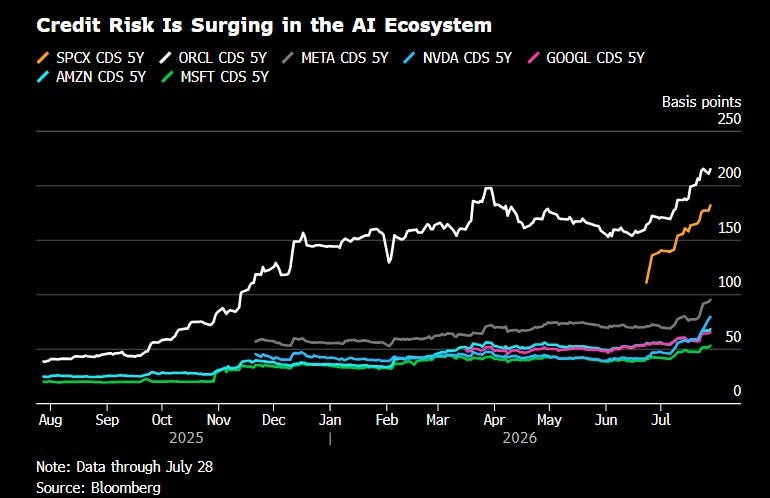
Meta's free cash flow fell 91% to $784mn. The five largest names issued $159bn of bonds in the first half, up 47% on last year, and technology now accounts for 18% of all US corporate debt issuance.
The Cost of Capital Is One Thing That Can Break This
If the AI build is now debt funded, then the rate on that debt is the actual risk variable, and it is going the wrong way.
 |
The 30 year Treasury printed 5.244% on July 29, its highest since 2007, and sits near 5.21%. The 10 year touched 4.73% on August 2, an 18 month high, and is at 4.70%.
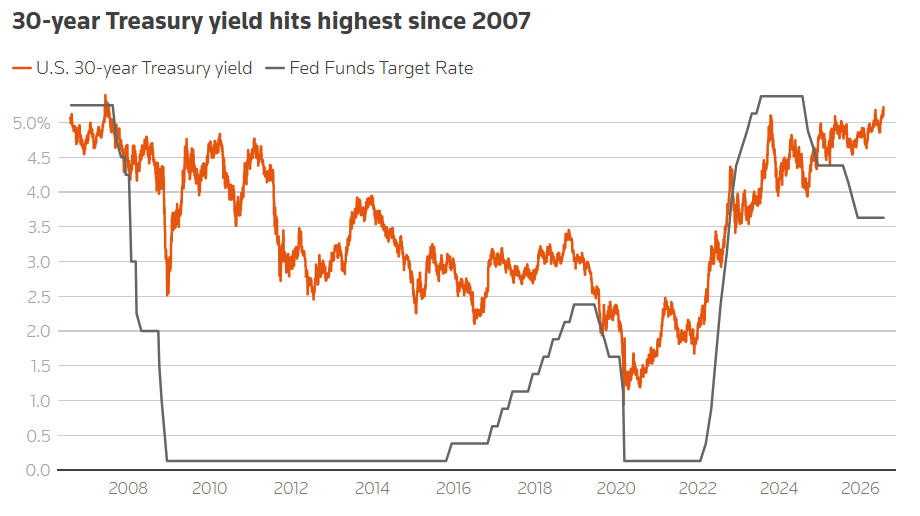 |
The Fed held at 3.50% to 3.75% in a 9 to 3 vote, and all three dissenters wanted a hike, the first three way dissent since 2016. Q2 GDP came in at 1.5% against a 2.1% consensus, while core PCE is still 3.3%.
Proflex Macro Discussion Group
Join our invite-only, expertly moderated WhatsApp group—where macro meets community.
Tap into real-time commentary from Proflex experts on market shifts, policy cycles, and global events—alongside daily discussions from 190+ Silicon Valley CTOs, CEOs, family offices, and seasoned HNIs.
Proflex Exclusive Investor CommunityThe hard assets are telling you where the money went. Gold sits at $4,061, roughly 10% below its 200 day average and 28% off its January peak, even though central banks bought a record 289 tonnes in Q2 and 533 tonnes in the first half.
Silver is at $58 after peaking at $116 in January.
Bitcoin is near $62,700, down 11% on the year, with IBIT posting outflows in 54% of sessions.
The Week Ahead: Jobs, Refunding and 140 Reports
First week of the month, so the full labor sequence runs. ISM manufacturing and the Senior Loan Officer Survey landed Monday, ADP and June JOLTS at 7.62 million on Tuesday, ISM services Wednesday, Challenger cuts plus Q2 productivity and unit labor costs Thursday, and the July Employment Situation report on Friday.
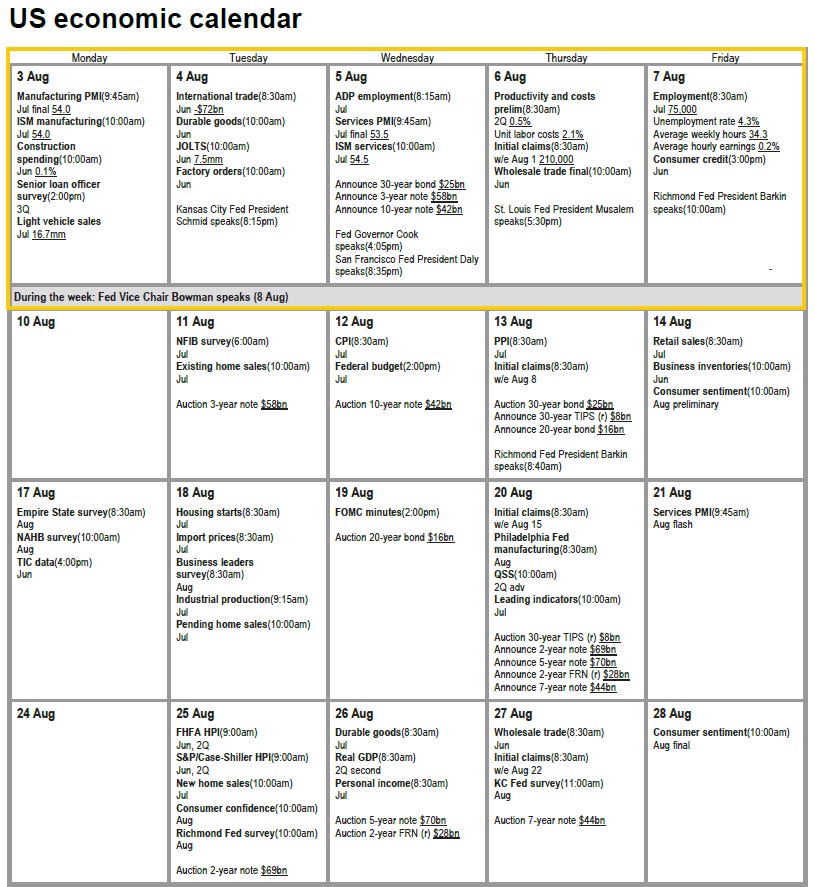 |
Fed speakers are light: Cook, Musalem Thursday, Barkin Friday.
The refunding is the one to watch.
Monday brought the quarterly borrowing estimate, and Wednesday brings the auction sizes by maturity along with the forward looking guidance.
With the 30 year at a 2007 high, Scott Bessent has every reason to avoid signaling an increase in long end supply, and most expect that increase eventually. That statement matters more than any of the data.
Earnings are heavy in count if not in weight: 140 S&P names, 23 above $100bn. AMD reports Tuesday with roughly a 10% move implied, alongside Caterpillar, Merck, Arista, Amgen and McDonald's. Palantir went Monday. Eli Lilly, Disney, Uber, AppLovin, SanDisk and Western Digital land Wednesday.
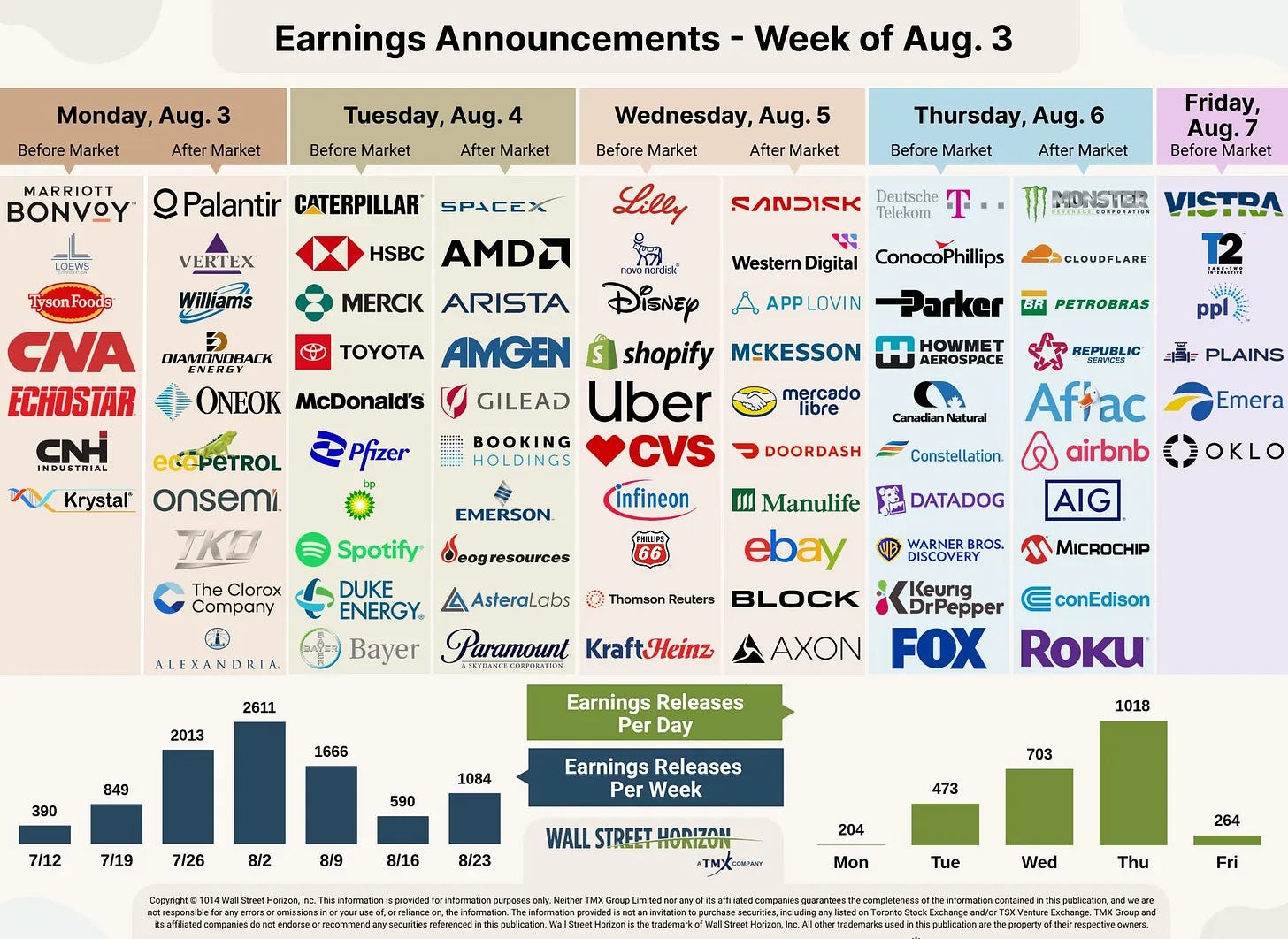 |
SpaceX files its first report as a public company on Tuesday, with about $6.88bn of revenue expected.
The scorecard so far is the most interesting number of the season. With 61% reported, 86% have beaten EPS and blended growth is 37.9%, with the average beat 31.4% above estimates, the largest since FactSet began tracking in 2008. Strip out Alphabet and Amazon and growth is 9.2%.
🔍 What We're Watching
- The 30 year at 5.25%, and whether Wednesday's refunding statement hints at more long end supply
- Whether semis hold Thursday's reversal or retest, now that the Korean retail bid is regulated away
- AMD Tuesday as the read on whether AI demand or memory cost is setting the margin
- Brent near $88 after a 24% July, with Kalshi odds on Hormuz normalizing by September 1 down to 8% and the January 1 contract at 46%, from 48% last week
🧭 Proflex Playbook – Buy the Progression, Not the Narrative
The AI trade is delivering earnings progression while the market re litigates the bull case. That gap between what the numbers say and what the tape says is where the opportunity is, provided you are in the right half of the supply chain.
Our conviction stays anchored in the data:
- Focus on Structural Growth: Continue to overweight the secular AI theme, recognizing its multi-year runway.
- Anticipate Shallow Corrections: Use dips as accumulation opportunities, not reasons for fear, understanding that "none of the corrections stick."
- Diversify Thoughtfully: Recognize the "decorrelation" across asset classes; consider gold, silver and Bitcoin for portfolio resilience.
- Develop Mental Models: Prioritize long-term planning (6-12 months out) over short-term news, aiming for consistent, incremental gains.
If you're an All-Access or Managed Portfolio subscriber, our positioning has already shifted ahead of this moment—scaling up asymmetric hard asset plays while hedging for earnings volatility and geopolitical tail risks.
| Proflex All-Access Subscription (Yearly) |
| Proflex All-Access Subscription (Monthly) |
Until next week,
— The Proflex Team
Trusted Macro Insights. Calm Investing. Tactical Trades.
Legal Disclosures