Fed Hikes, Dots Say More | $7 Trillion Expiry Resets the Tape | Semis Recovery | Oil and the Midterms
"The Fed is hiking, the 10 year sits at 5% and oil is above $100, and the market has stopped panicking about any of it. With $7 trillion of options gone, the only question left is whether semiconductors lead again." — Proflex Panel
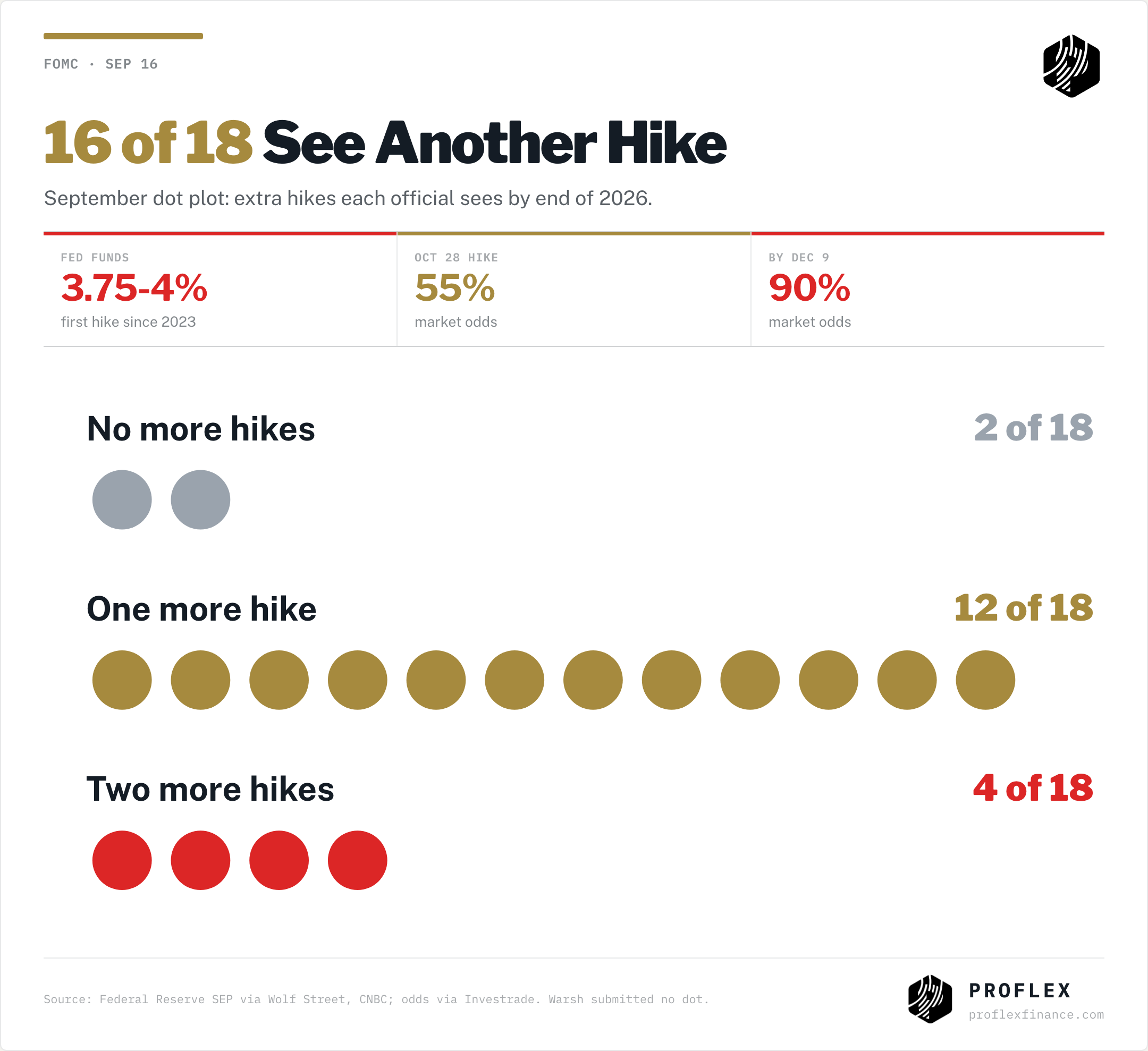
The Fed raised rates on Wednesday for the first time since 2023, by 25 basis points to 3.75% to 4%, and the vote was 12 to 0. The dot plot then showed 16 of 18 officials expecting at least one more hike this year. The 10 year closed Friday at 5.01%. Brent traded near $110 on Monday after the attack on the Saudi pipeline.
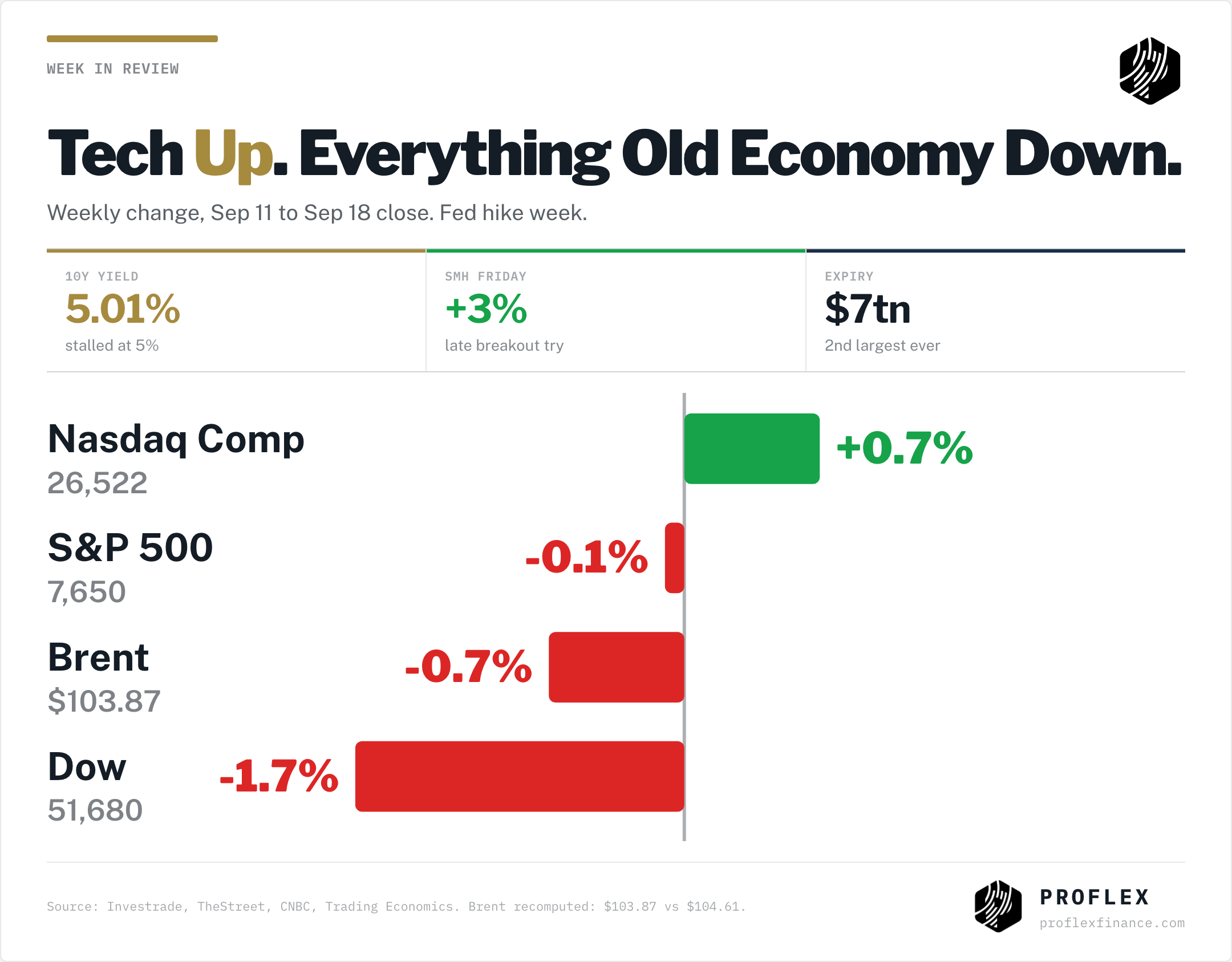
The S&P 500 finished the week at 7,650, down just 0.1%. The Nasdaq rose 0.7% and the Dow fell 1.7%. On Friday, around $7 trillion of options expired, the second largest expiry on record (Citadel Securities), and in the last hours of trading the chip stocks that had led the market down for three months staged their strongest bounce in weeks. The semiconductor ETF closed up close to 3%.
This is a market that has made peace with high rates. It has not yet made peace with the AI trade. With the options cushion gone, this is the first week in three months in which the market can trend. The question is whether it trends up with semiconductors or down without them.
Insights from the Proflex Macro Call
Options expiry is now a market event, not a footnote. Quarterly expiries were about $3 trillion not long ago, then $5 trillion, and now $7 trillion. That much hedging pins the index in place while money rotates underneath it. As Raman put it, trends often form right after these quarterly resets, because only 20% to 50% of the position rolls over on Monday and the support rebuilds slowly.
Semiconductors are the tell. The S&P is close to its record, but the Nasdaq has not made a new high. Microsoft has stalled, Google and Amazon have corrected hard, and names like Broadcom, Micron, Intel and Marvell are well below their recent highs. "There is a lot of juice left if the rally comes back in AI stocks." The level to clear is $600 on the semiconductor ETF.
The AI slowdown talk is not a slowdown. The same companies calling for caution are signing ever larger data center contracts and hunting for powered sites abroad. Raman reads the push for oversight as a way for the leaders to protect their lead. Regulation raises the cost of entry for everyone chasing them.
High yields plus rising risk assets is a coherent setup. If the Treasury keeps funding at the short end to hold down the long end, money supply keeps growing even while rates stay high. That is a hidden stimulus, and it is why Bitcoin is rising alongside yields.
The midterm risk runs through Iran, not tariffs. Tariffs are largely priced into a market that is now "all or nothing on AI". The bigger worry for the next month is Iran and its proxies stepping up attacks to raise the cost of the war before November. The Saudi pipeline strike was timed for exactly that.
Last week we said a 25 basis point hike was priced and was not the risk; the risk was the dots showing more than one. That is what the dots showed. Of the 18 officials, 12 see one more hike by year end and 4 see two, so 16 expect at least one more (Federal Reserve projections). Warsh again submitted no dot of his own. "I’m not in the forward guidance business," he told reporters.
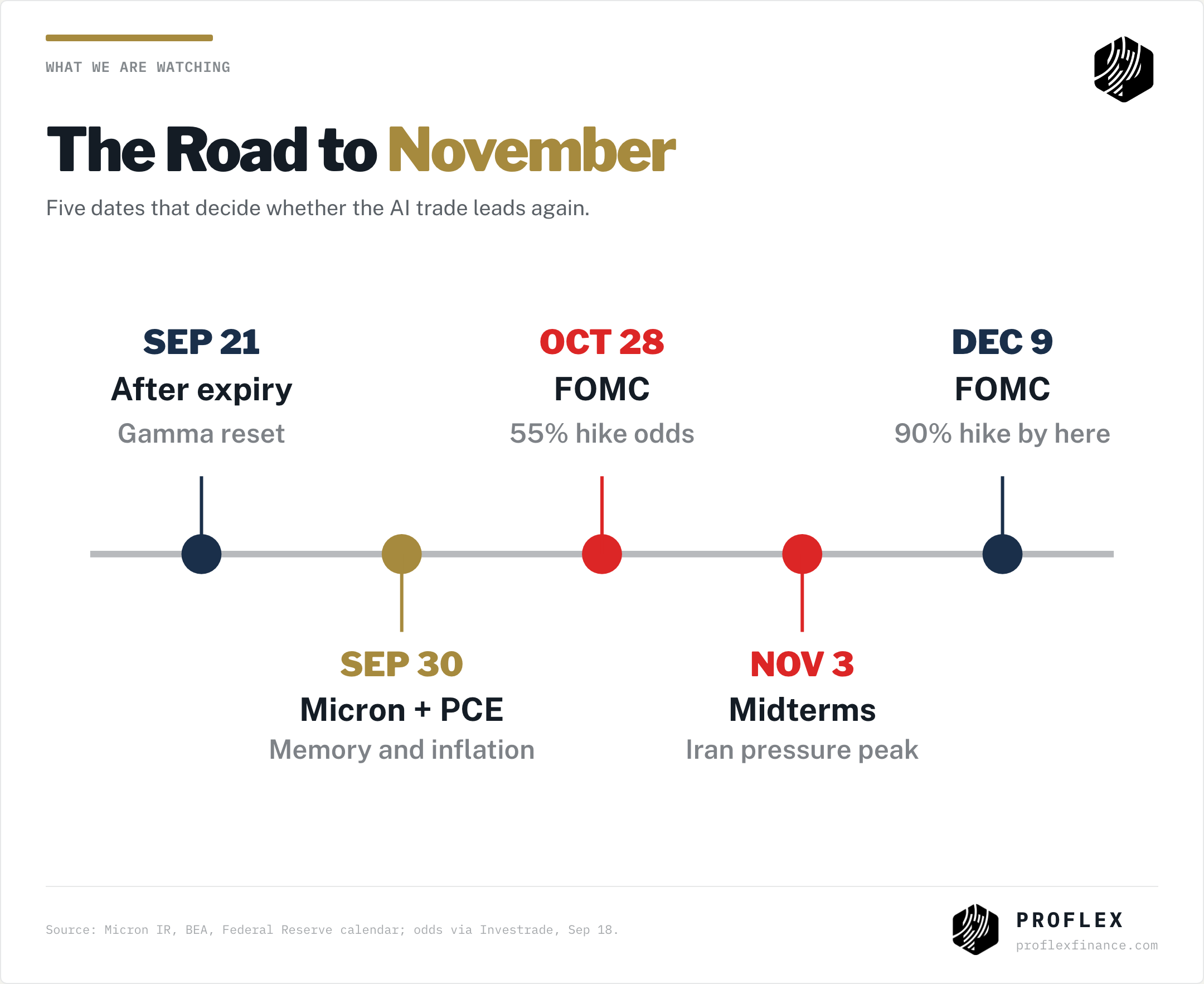
Markets moved quickly to price it in. Futures now put the odds of a hike by the December 9 meeting at about 90%, with a 55% chance it comes on October 28. The unanimous vote mattered too. It was the clearest sign yet that the Fed will act on inflation in an election year.
Proflex View: The Fed has gone from "will it hike" to "how many", and the long end barely reacted. That is the real signal. A Fed that shows it is serious about 2% gives bond buyers a reason to hold the 10 year at 5% rather than sell it. We see the market adjusting to higher rates, not breaking because of them.
$7 Trillion Expired. The Cushion Is Gone
Two weeks ago we called the record expiry a volatility risk, not a direction risk, and last week we said Friday’s expiry would reset dealer positioning. Citadel Securities now says the same thing. Its team, led by Scott Rubner, said 60% of the $7 trillion expired at the open and called it a "potential reset in the market’s technical backdrop". The hedging that kept daily moves small is gone, so prices should respond more to real buying and selling.
History leans cautious. Since 2000, about 75% of September triple witchings were followed by lower prices five sessions later. But Friday was also the first day in three months that semiconductors tried to break their downtrend, and a trend that starts right after the reset is the one to respect.
Proflex View: Raman’s point on the call is the one to hold on to: at this scale, index hedging moves prices more than the headlines do. Blue chips are moving 15% to 20% in a week, and stop losses are getting triggered right before the recovery. That argues for a longer holding horizon and smaller position sizes, not for sitting out.
The AI Slowdown Scare, And The $600 Test
The week opened with a scare. Anthropic’s Dario Amodei called for slower frontier AI development, and Sam Altman, Elon Musk and Microsoft agreed. Chip stocks fell around the world. SK Hynix dropped 5.3%, SoftBank as much as 13.2% and Kioxia 9.8% at one point (Taipei Times, CNN). President Trump played the risk down and pointed to America’s lead over China. Deutsche Bank’s view was the most sensible: "it’s difficult to imagine firms voluntarily stepping back while rivals continue to push ahead." (Semafor)
Free Weekly Insights
Get This Analysis Every Week
Join 250+ investors at Google, Amazon & Apple who start their week with Proflex.
No spam. Unsubscribe anytime.
By Friday the chips had recovered. There was also one more signal. CNBC reports that Leopold Aschenbrenner’s Situational Awareness is buying again, with options on AMD, CoreWeave, SK Hynix, SanDisk and the Roundhill Memory ETF. This is the same fund that shrank from about $45 billion to $10 billion in July on leverage of up to 400%. In late July we wrote that the fundamentals did not break, the leverage did. Two months later, the leverage is coming back to the same trade.
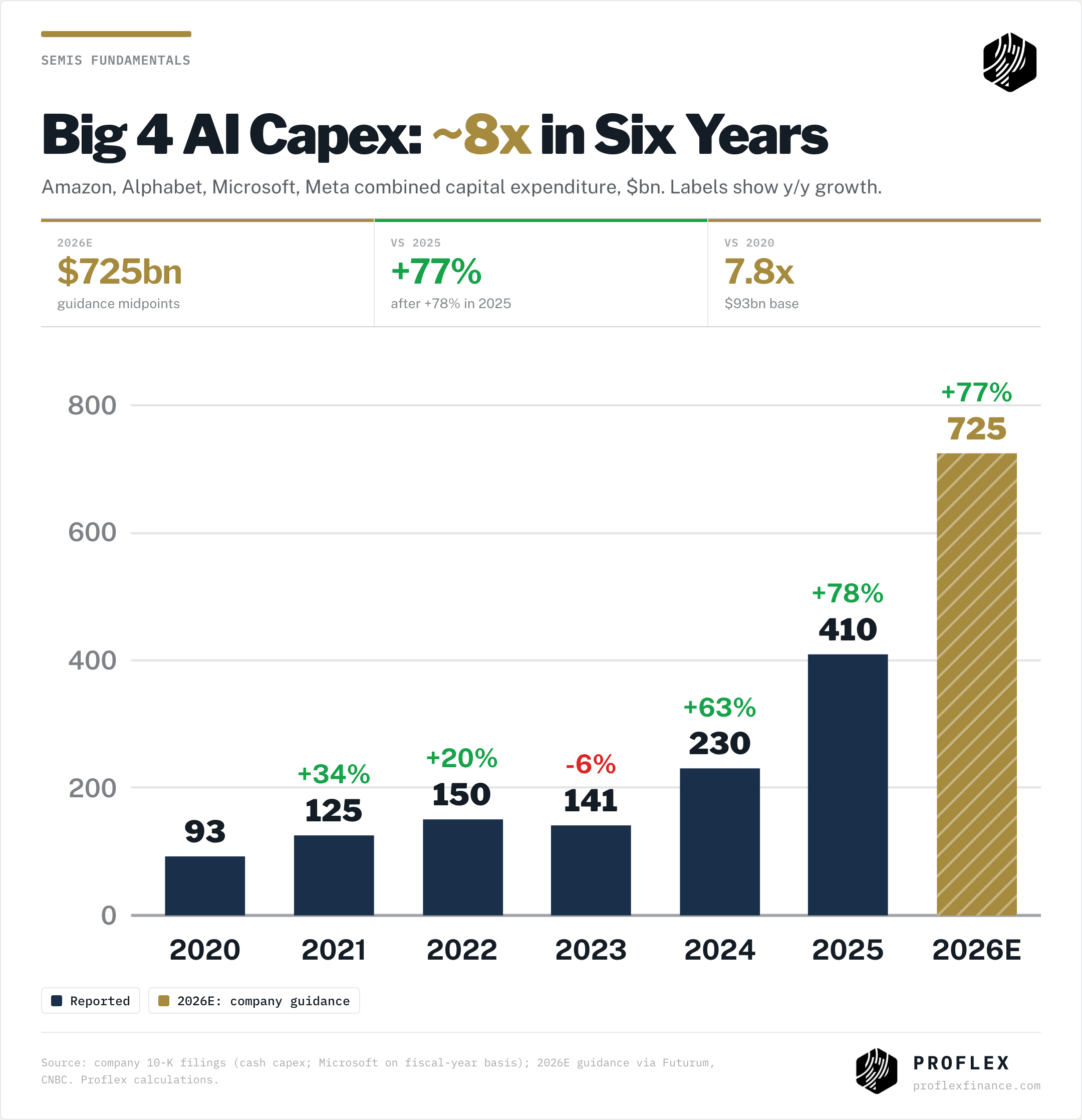
Proflex View: The semiconductor ETF closed at $572.84, up 59% this year but about 15% below its $671.83 high. A close above $600 is the level that confirms the AI trade is leading again, and with it the broader market. Underneath the price, the demand has not moved. Amazon, Alphabet, Microsoft and Meta have guided to about $725 billion of capex this year, up 77% from $410 billion in 2025, which was itself up 78%. That is close to 8x the $93 billion they spent in 2020 (company filings, Futurum). Nobody talking about a slowdown has cut that number. Until the ETF clears $600, Friday is a bounce, not a breakout. Micron’s results on September 30 are the next fundamental test.
Oil, Iran And The Road To November
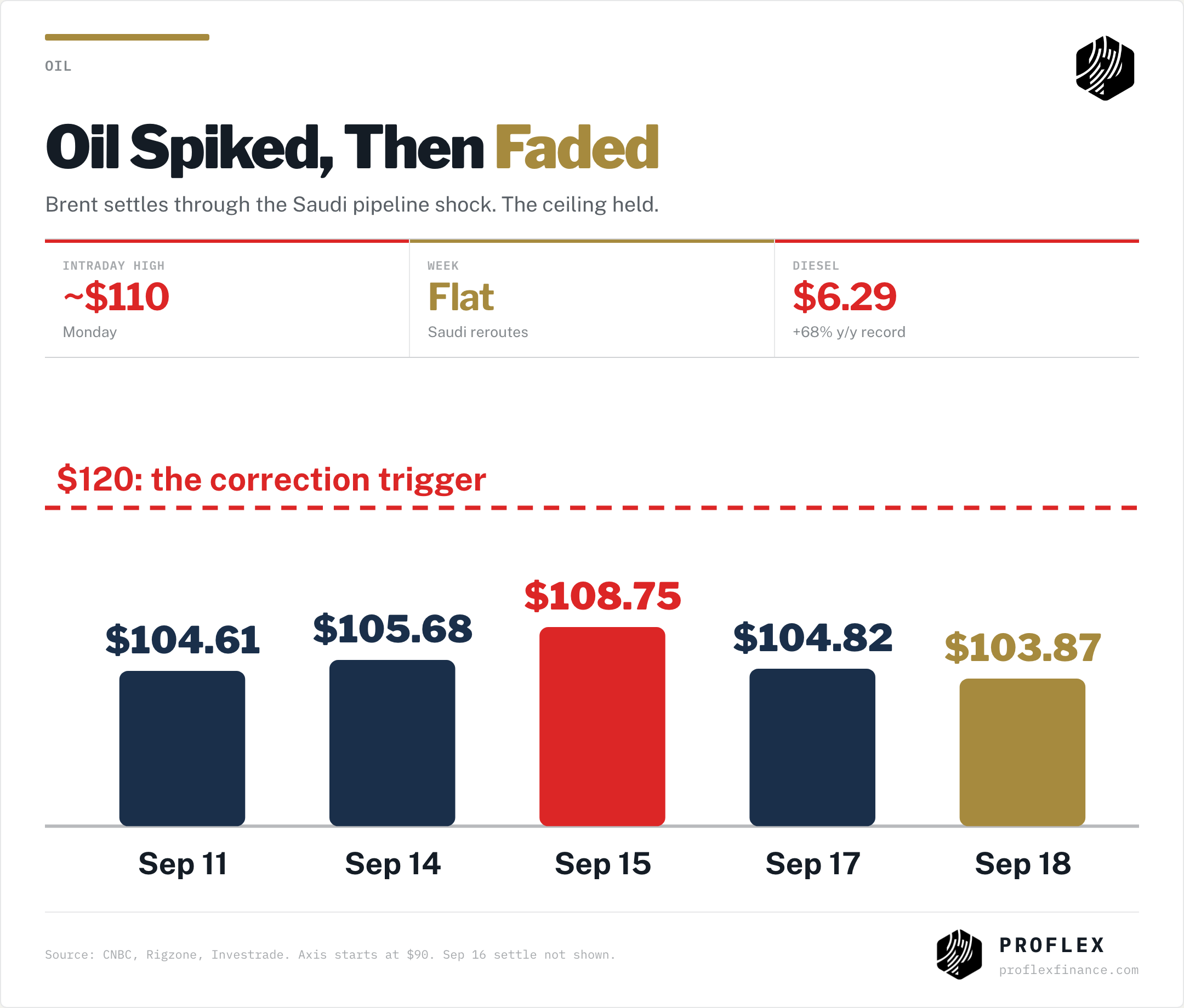
Brent settled at $105.68 on Monday after drones damaged Saudi Arabia’s East West pipeline, then $108.75 on Tuesday. It faded once reports said Saudi Arabia was sending more crude through Hormuz and speeding up repairs. It closed the week at $103.87, about flat (CNBC). The damage showed up elsewhere. Diesel hit a record $6.29 a gallon, up 68% from a year ago, and refiners like Marathon Petroleum hit record highs.
Last week we named Brent at $120 as the single clearest trigger for a real correction, and that ceiling held even through a direct hit on Saudi supply. Raman’s concern is what comes next. Iran cannot win this war militarily, but it can make it more expensive for Washington, and the two months before the November 3 midterms are when that pressure counts most.
Proflex View: The market treated a direct attack on the Hormuz bypass as a supply shock it could absorb, and that is constructive. The risk is repetition. More strikes timed to the election would keep diesel and headline inflation high just as the Fed signals more hikes. We are watching $120 Brent and nothing else.
Tap into real-time commentary from Proflex experts on market shifts, policy cycles, and global events—alongside daily discussions from 190+ Silicon Valley CTOs, CEOs, family offices, and seasoned HNIs.
Two weeks ago we said we stay constructive on Bitcoin, because gold was competing with a 5% risk free rate and Bitcoin was competing with nothing. Bitcoin then printed its first golden cross of 2026, with its 50 day average ($73,535) crossing above its 200 day ($73,077), and it traded near $77,566, about 6.1% above that 200 day average (CoinDCX). An SEC exemption for blockchain securities helped late in the week.
The bigger reason is the one Raman laid out. Treasury Secretary Bessent has doubled buybacks of long bonds to $4 billion per operation through November 4 and calls it a "Treasury Twist": buy back the long end and fund it with short term bills. Treasury officials told CNBC the nearly $1 trillion Treasury General Account could help fund it. Gold rose toward $4,400 on Friday as oil eased, but it is still lagging and has not broken out.
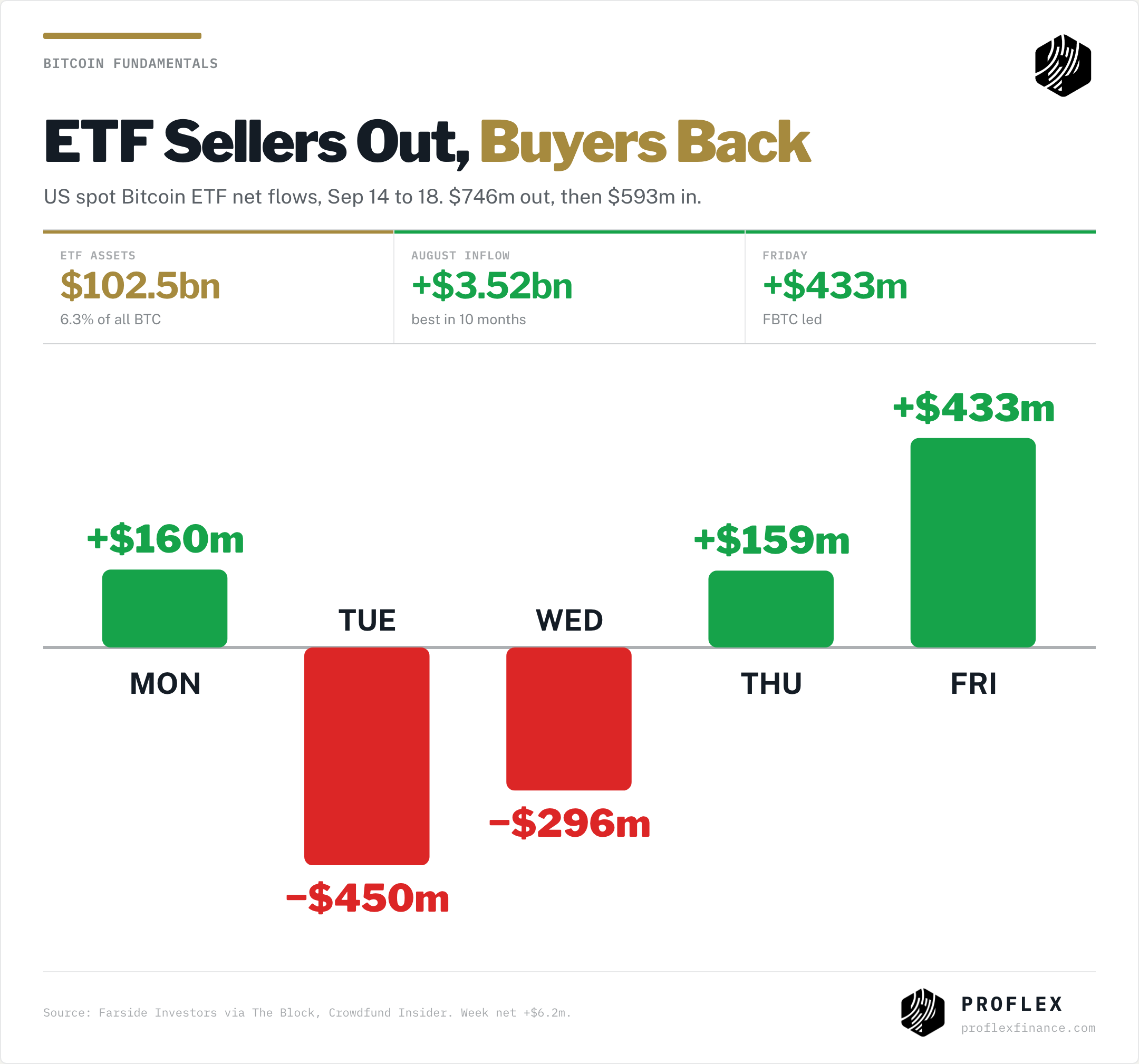
Proflex View: Rates can stay high and money supply can still grow, as long as the Treasury funds at the short end. Bitcoin is the asset responding most directly to that, and the buyers are institutions. US spot ETFs lost $746 million on Tuesday and Wednesday, then took back $593 million on Thursday and Friday, $433 million of it on Friday alone. The funds now hold $102.5 billion, about 6.3% of all Bitcoin, after August brought $3.52 billion of inflows, the best month in ten (The Block, Crowdfund Insider). The level to watch is $80,000, with $75,000 as the support to defend. Gold and silver need to break out before we get more constructive on them.
🔍 What We’re Watching
The semiconductor ETF against $600: a close above it confirms the AI trade is leading again
How much hedging rolls into the new quarter this week, and whether the S&P moves more now that the expiry cushion is gone
Brent against $120 and any new strikes on Gulf energy before the midterms
The 10 year holding near 5% as markets price the next hike
Micron results and PCE inflation, both on September 30
🧭 Proflex Playbook – Lengthen the Horizon, Not the Stop Loss With $7 trillion of options gone, the cushion that kept moves small has been removed. Blue chips can move 15% to 20% in a week and reverse the next. Size positions so a bad week does not force a sale, and judge the AI trade on a 6 to 12 month view, not a daily one. Our conviction stays anchored in the data:
Focus on Structural Growth: Continue to overweight the secular AI theme, recognizing its multi-year runway.
Anticipate Shallow Corrections: Use dips as accumulation opportunities, not reasons for fear, understanding that "none of the corrections stick."
Diversify Thoughtfully: Recognize the "decorrelation" across asset classes; consider gold, silver and Bitcoin for portfolio resilience.
Develop Mental Models: Prioritize long-term planning (6-12 months out) over short-term news, aiming for consistent, incremental gains.
If you're an All-Access or Managed Portfolio subscriber, our positioning has already shifted ahead of this moment—scaling up asymmetric hard asset plays while hedging for earnings volatility and geopolitical tail risks.
Proflex All-Access: Your Market Compass
Explore the financial markets with Proflex All-Access, your comprehensive resource for deeper market understanding and active participation. This premium service offers subscribers exclusive insights and actionable investment advice, giving you a significant edge in various market conditions.
Proflex All-Access provides detailed analyses and recommendations to optimize your investment strategy. Our specialized newsletters include:
• Growth Gazette (Contains Crypto Pulse) : Aimed at achieving above-market returns for aggressive portfolio growth.
• Income Insider: Focused on conservative strategies and income generation for yield-seeking investors.
Until next week, — The Proflex Team Trusted Macro Insights. Calm Investing. Tactical Trades.
Elevate your financial IQ
ProFlex® by Proflex Finance Legal Disclosures
ProFlex® by Proflex Finance, the premium newsletter product series, provides informational and educational content only and does not offer personalized investment advice or establish a fiduciary relationship. While we rely on reliable sources and research, the information is not tailored to individual financial situations. Readers are urged to consult qualified financial professionals before making investment decisions. We do not guarantee the accuracy, completeness, or timeliness of the information and are not responsible for any investment decisions based on this newsletter. Investing carries risks, and past performance doesn't predict future results. By accessing this newsletter, you acknowledge that we are not liable for actions or decisions resulting from its content. Please conduct due diligence and seek professional advice as needed.
Frequently Asked Questions
The Fed targets 2% inflation measured by the PCE index. When CPI or PCE readings come in above target, the Fed may maintain or raise rates to cool the economy. Below-target readings give the Fed room to cut rates. Markets watch these releases closely because they signal the direction of monetary policy.
Oil prices are driven by supply-demand dynamics, OPEC+ production decisions, geopolitical tensions in producing regions, and global economic growth expectations. Rising oil prices increase input costs for businesses, pressure consumer spending, and can signal inflationary pressures that influence central bank policy.
Earnings reports reveal actual business performance versus market expectations. Revenue growth, profit margins, and forward guidance drive stock re-ratings. Beats or misses relative to consensus estimates move individual stocks and can shift sector-wide sentiment. Earnings season also provides insight into broader economic health and consumer spending trends.
Massive capital expenditure on AI infrastructure (data centers, GPUs, networking) is creating a new investment super-cycle. Companies like NVIDIA benefit directly from hardware demand, while hyperscalers (Microsoft, Google, Amazon) invest billions in AI capabilities. This spending flows through to semiconductor suppliers, power utilities, and cooling technology companies, creating multi-layered investment opportunities.
Options expiration (especially quarterly "triple witching") can create significant short-term volatility as dealers unwind hedging positions. Gamma exposure determines whether dealer hedging amplifies or dampens moves. Negative gamma environments can accelerate selloffs, while positive gamma tends to suppress volatility. Large open interest strikes often act as price magnets into expiry.