Proflex Aug 17–21 — NVIDIA Wednesday, Warsh at Jackson Hole, Treasury Buybacks
Proflex Market Update — Week Aug 17-21, 2026
NVIDIA Wednesday | Warsh at Jackson Hole | Treasury Doubles Buybacks | Iran Economic D-Day
"Last week the market stopped trading earnings and started trading the currency. Gold, silver, Bitcoin and oil all went up while the S&P went down, in the same week the Treasury said it would double its bond buybacks. NVIDIA on Wednesday is the test of whether earnings can take the wheel back." — Proflex Panel
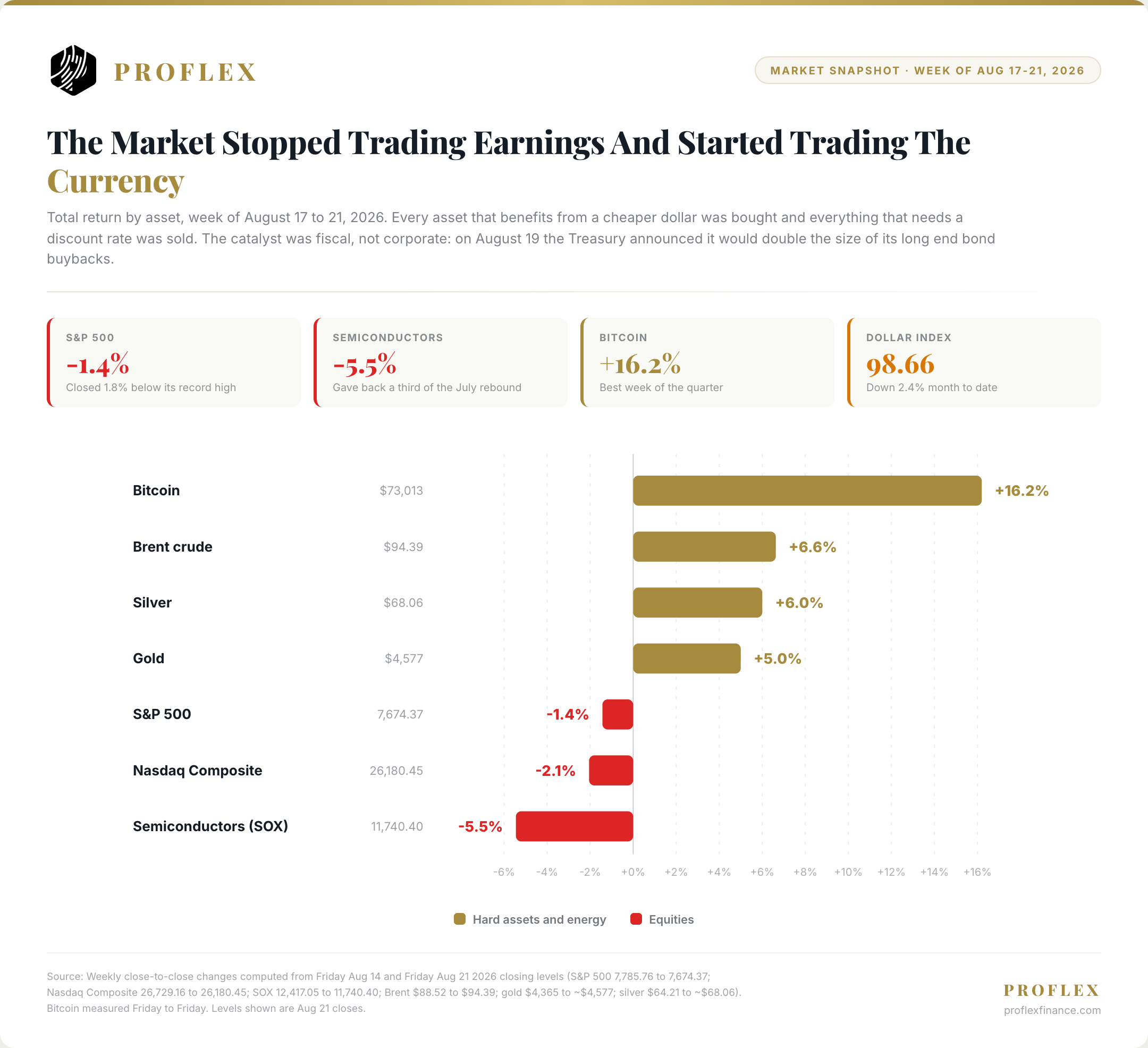
The S&P 500 closed Friday at 7,674, down 1.4% on the week and roughly 1.8% below the 7,814 all time high it printed only days earlier. The Nasdaq Composite fell 2.1%. Technology as a group lost more than 3%.
Now look at what went up in the same five sessions. Gold +5.0% to $4,577. Silver +6.0%. Bitcoin +16.2%, its best week of the quarter. Brent +6.6% to $94.39, a second straight weekly gain. The dollar index fell to 98.66, down 2.4% month to date. The 30 year yield pushed 5.26%.
That is not an earnings tape. That is a liquidity tape. Every asset that benefits from a cheaper dollar was bid, and every asset that needs a discount rate was sold. The catalyst was not corporate: on Tuesday the Treasury announced it will double the size of its bond buyback operations, and by this morning it was reported to be weighing whether to fund them out of a cash account holding close to $1 trillion.
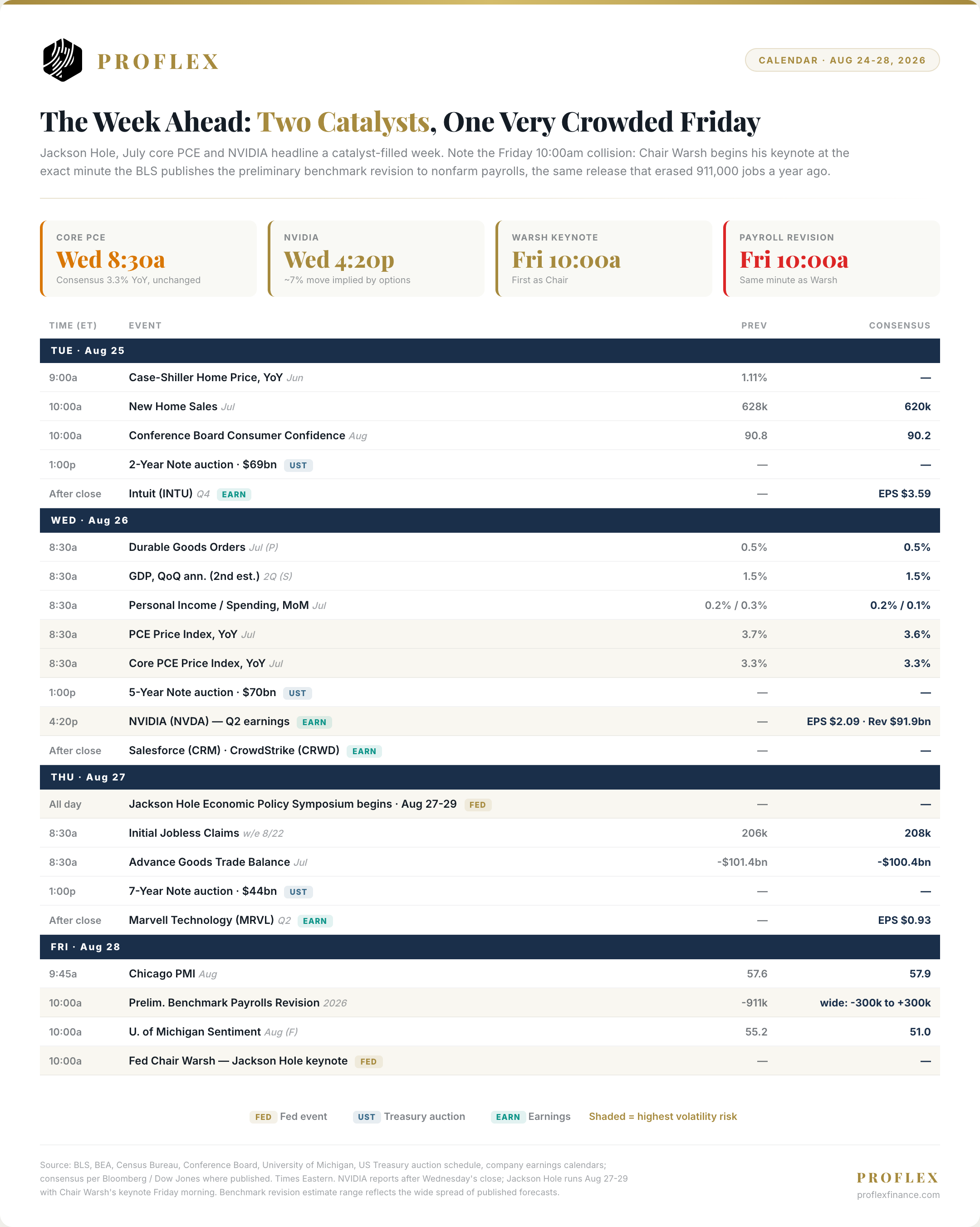
Into that, this week delivers the two largest scheduled catalysts of the quarter. NVIDIA reports Wednesday after the close. Fed Chair Kevin Warsh gives his first Jackson Hole keynote Friday at 10:00am ET, at the exact minute the BLS releases a benchmark revision that can restate a full year of job growth.
The question this week is not whether AI is real. The income statements settled that. The question is whether an earnings beat is still enough to move a market that has started pricing the denominator instead of the numerator.
Key Drivers This Week
NVIDIA Wednesday: The Whole Week Fits Into One Print
Two weeks ago we wrote, in this letter, that "NVIDIA on August 26 is the next proof point: if data center revenue comes in above the $91 billion guide, the rotation back into semis accelerates meaningfully." Wednesday is that date. Here is the bar.
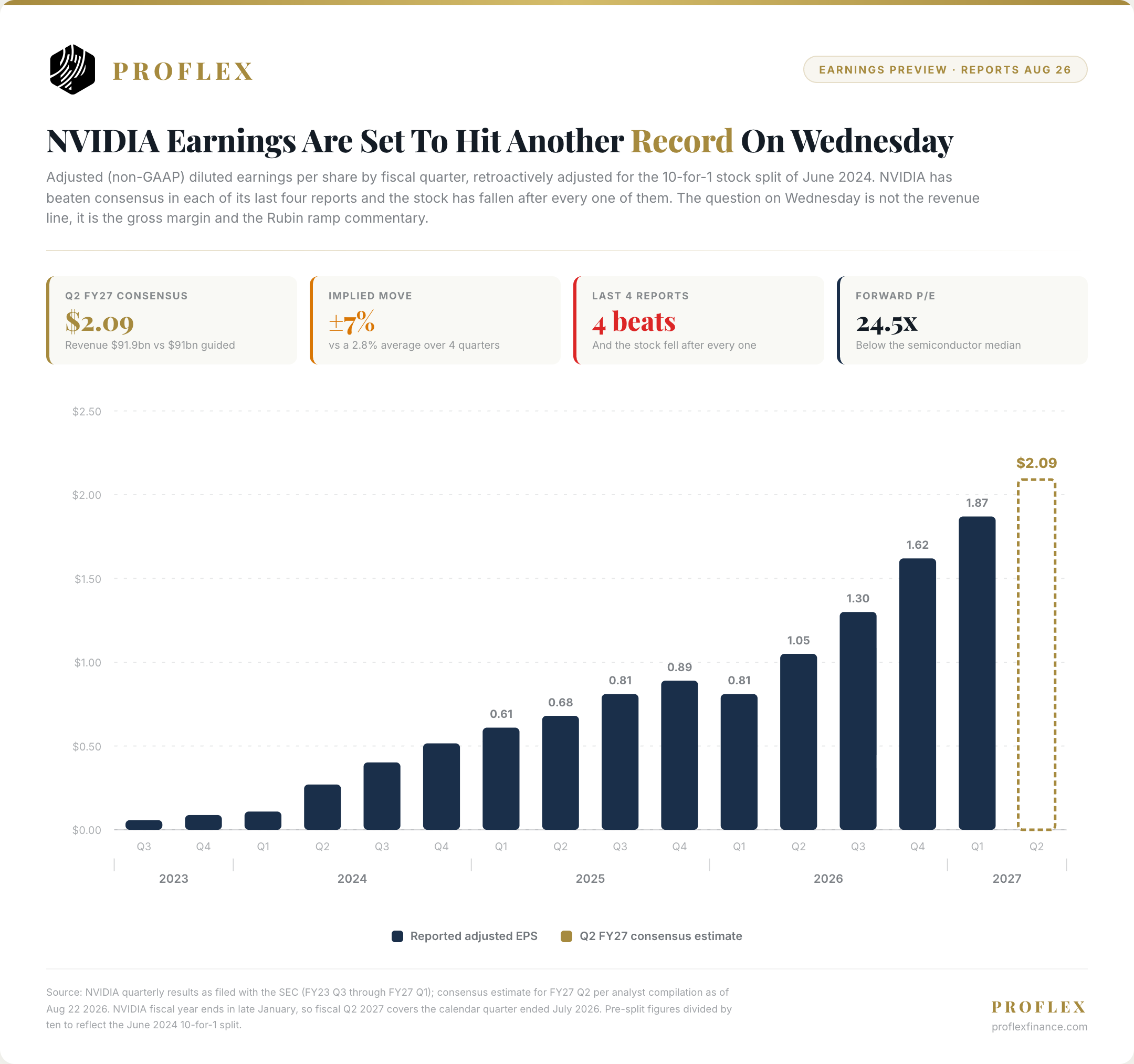
Consensus revenue $91.9 billion against the company's own guide of $91 billion plus or minus 2%. Consensus EPS $2.09.
Data center revenue consensus above $85 billion, which would be growth of roughly 107% year over year.
Last quarter delivered $81.6 billion total revenue (up 85%) and $75.2 billion in data center (up 92%) at a 75% non GAAP gross margin.
The stock trades near $215 at a $5.28 trillion market cap and a forward P/E of 24.5x, below the semiconductor median.
Now the part almost nobody is pricing correctly. Options imply a move of roughly 7% into Thursday. The average realised move over the last four quarters was 2.8%. The market is asking for two and a half times the normal reaction. And NVIDIA has traded lower after each of its last four reports, every one of which was a beat.
That is the real setup. This is not a company that has been missing. It is a company whose results keep clearing the bar while its stock keeps selling the news. Four consecutive times, the print was good and the tape was bad. The variable that decides Wednesday is therefore not the revenue line. It is gross margin and the Rubin ramp commentary, because that is where the bear case now lives: rising HBM and memory input costs compressing the best margin structure in semiconductors. NVIDIA is reportedly evaluating 8 high rather than 12 high HBM4 stacks for Rubin Ultra precisely because memory is the binding constraint.
The demand side is not in question. Combined 2026 hyperscaler capital expenditure sits at $725 billion, up 77% from $410 billion in 2025, with the street now modelling above $1 trillion for 2027. Amazon has told investors capacity constraints persist through 2027. Global semiconductor sales were $403 billion in Q2 alone, up 35% from Q1 (SIA). TSMC printed $14.5 billion in July revenue, up 44.7%. SK Hynix posted a 76% operating margin.
Proflex View: The bar is a beat and a raise, and we expect NVIDIA to clear it. The risk is not the quarter, it is the reaction function. Four straight beats have been sold, so a fifth beat that is merely in line with the whisper gets sold too. What would genuinely change the tape is gross margin held at 75% with an explicit statement that memory costs are contracted rather than floating. Get that, and the semis rotation we have been describing since early August finally has its trigger. Miss on margin, and the AI trade spends September arguing about input costs instead of demand.
Jackson Hole: Warsh's First Keynote, and a 10:00am Collision
The Kansas City Fed's symposium runs August 27 to 29 at Jackson Lake Lodge, and this year's theme is "Financial Innovation: Implications for Payments and Policy". Around 120 officials from more than 70 countries attend. The event that matters is Chair Warsh's keynote, Friday at 10:00am ET, his first as Chair.
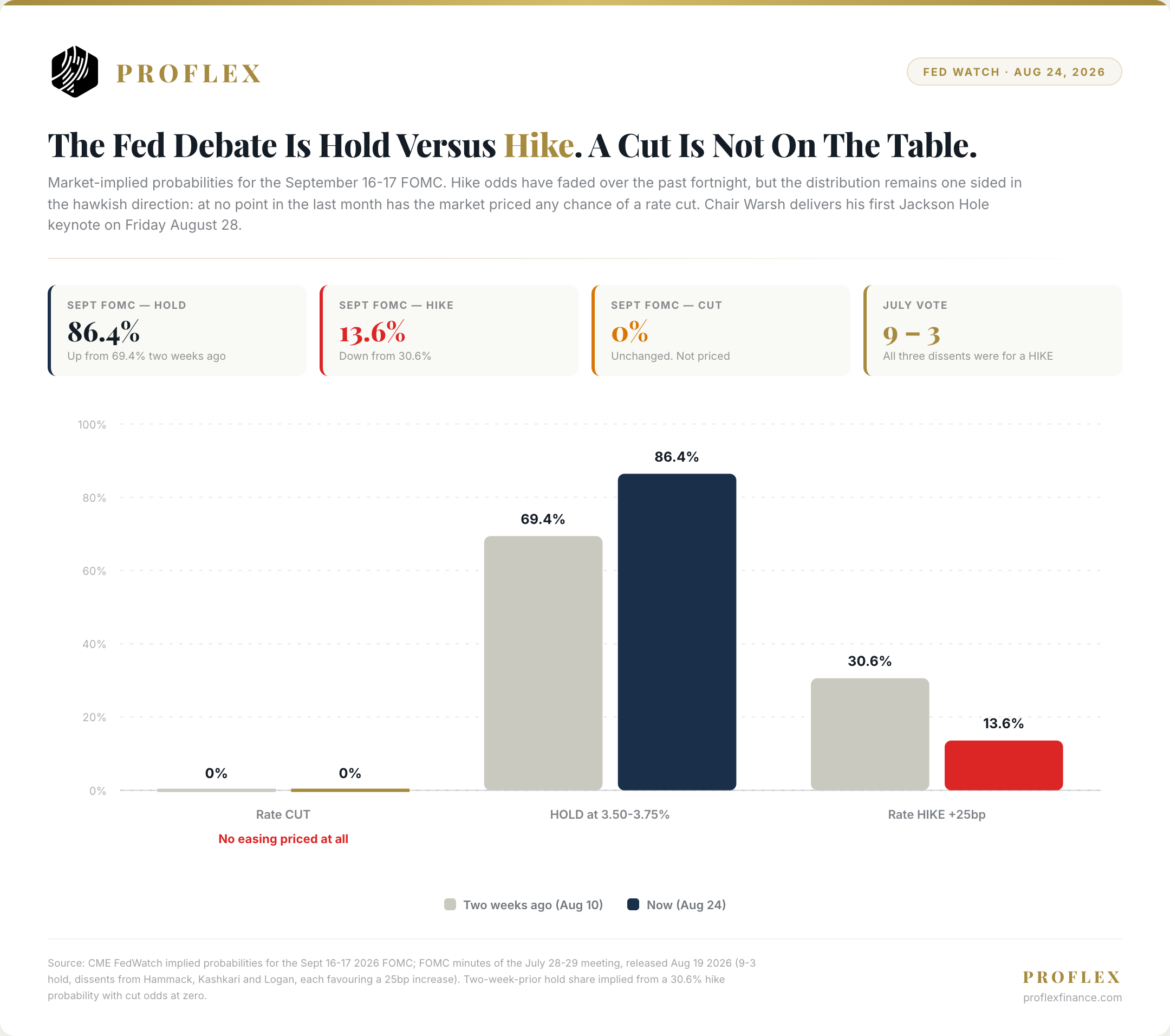
He walks in with a divided committee behind him. The July minutes, released August 19, showed a 9 to 3 vote to hold at 3.50% to 3.75%, with Hammack, Kashkari and Logan all dissenting in favour of a hike. Participants recorded that "policy tightening would likely be necessary if inflation did not decline." Warsh also used the meeting to open a discussion on cutting the FOMC calendar from eight meetings to six.
Read the market pricing carefully, because the interesting number is the one at zero. For September, futures put a hold at roughly 86%, with a 25 basis point hike as the only live alternative and a cut priced at essentially zero. Hike odds have faded from above 30% a fortnight ago, but the distribution is still one sided in the hawkish direction. There is no easing in this curve at all.
Then there is the scheduling. At 10:00am Friday, the same minute Warsh begins speaking, the BLS publishes the preliminary March 2025 to March 2026 benchmark revision to nonfarm payrolls, truing the establishment survey up against actual state unemployment insurance records. Last year the same revision erased 911,000 jobs and cut average monthly payroll growth from about 147,000 to roughly 71,000. Published estimates for this cycle run anywhere from minus 300,000 to plus 300,000. Coverage has been remarkably thin.
Proflex View: Two market moving events at the identical timestamp is a liquidity problem before it is a macro problem: the tape has to price a labour market restatement and a new Chair's framework in the same sixty seconds. We would treat Friday morning as the single highest volatility window of the week, ahead of NVIDIA. On substance, Warsh has spent a decade arguing for a smaller balance sheet and a narrower Fed. If he uses a payments and innovation platform to talk about balance sheet size, that is far more consequential for the long end than anything he says about September.
Free Weekly Insights
Get This Analysis Every Week
Join 250+ investors at Google, Amazon & Apple who start their week with Proflex.
No spam. Unsubscribe anytime.
The Treasury Is the Real Liquidity Story: Buybacks Doubled, and a $1 Trillion Account
This is the development that moved markets last week and it received a fraction of the attention NVIDIA will get.
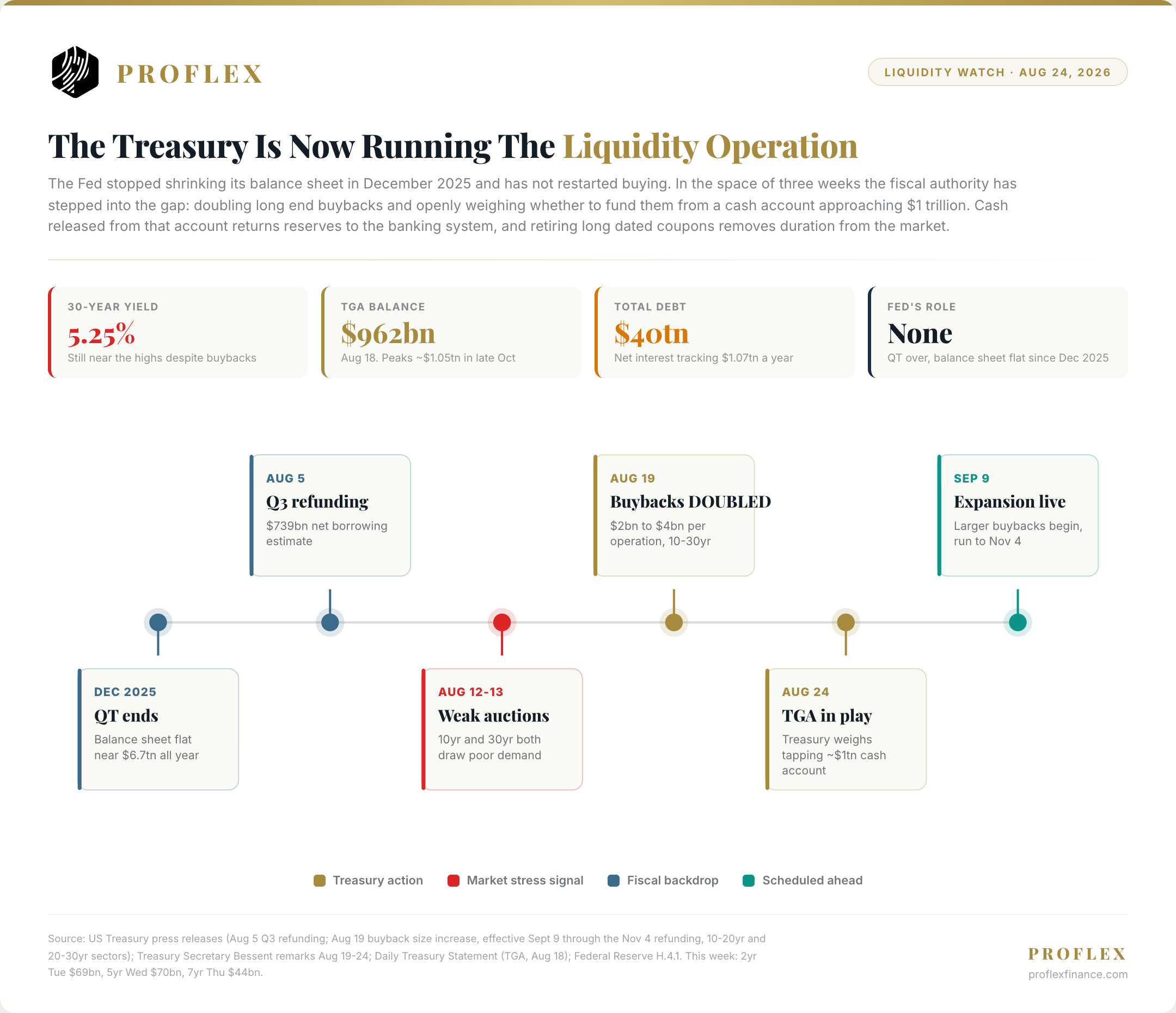
On August 19 the Treasury announced it is doubling the maximum size of its buyback operations from $2 billion to $4 billion, effective September 9 and running through the November 4 refunding. The purchases are concentrated in the 10 to 20 year and 20 to 30 year sectors. Secretary Bessent framed it as liquidity support, saying conditions in the 30 year sector were "very poor" and adding that operations "could be more than $4 billion per issue."
Then this morning came the second half. Treasury is reported to be weighing drawing on the Treasury General Account, its cash balance at the Fed, to help fund the expansion. That account sat near $962 billion on August 18 and is projected to peak around $1.05 trillion in late October, against a level closer to $550 to $600 billion under prior administrations.
Understand the mechanism, because the label matters less than the plumbing. Money sitting in the TGA is money withdrawn from the banking system. Spending it down adds reserves back. Using those reserves to retire long dated coupons takes duration out of the market. The Fed is not doing this: QT ended in December 2025 and the balance sheet has been flat near $6.7 trillion all year, with a Chair who wants it smaller. So the fiscal authority is running the liquidity operation the monetary authority has stopped running.
The context is why it is needed. Debt outstanding has crossed $40 trillion. Q3 net borrowing is estimated at $739 billion. Net interest expense is tracking $1.07 trillion for the fiscal year, more than Medicare and Medicaid combined. The August 12 10 year and August 13 30 year auctions both drew weak demand with elevated dealer take downs. This week brings 2 year Tuesday, 5 year Wednesday and 7 year Thursday.
The market read it immediately and correctly. Gold, silver and Bitcoin rallied. The dollar fell. Long bonds rallied on the announcement and the 30 year still sits at 5.25%. That is what it looks like when investors are handed more liquidity and more debt in the same sentence.
Proflex View: This is the most underpriced story in the market and it is why hard assets outperformed equities last week. Buybacks funded from the cash account are duration management that does not require the Fed's permission, and the hard asset complex understood that before the equity market did. We would not read the gold, silver and Bitcoin move as a risk off flight: it is a debasement bid, and it can run alongside a strong NVIDIA print rather than instead of it. Watch this week's 7 year auction Thursday as the cleanest tell. Another weak tail, into Warsh on Friday, and the long end becomes the story of September.
Iran: Economic D-Day Lands, and Oil Has Started Moving Again
As we said now eleven weeks ago, "we will just have to see how things progress." This week it progressed.
The additional economic pressure that had been trailed for Monday arrived. Secretary Bessent pre announced an "economic D-Day" for Iran, describing the package as "the single greatest financial offensive ever". The measures reportedly target any nation transacting with Iran across virtually any sector, which in practice means secondary sanctions aimed at China, Iran's largest trading partner. Tehran's national security chief responded that Iran would retaliate "in a seismic manner" and warned of ship seizures.
Tap into real-time commentary from Proflex experts on market shifts, policy cycles, and global events—alongside daily discussions from 190+ Silicon Valley CTOs, CEOs, family offices, and seasoned HNIs.
The physical picture has not improved. Transits are running near 10 vessels per day against a pre crisis baseline in the 88 to 130 range. War risk insurance sits at 3% to 10% of hull value against 0.25% before the war, so a $100 million tanker now pays up to $10 million per crossing. US gasoline averages $4.09 a gallon, roughly 37.5% above pre war. Iranian officials have restated that the Strait does not reopen until the US ends the war, withdraws troops and pays compensation.
And unlike the last several weeks, oil has stopped absorbing the news quietly. Brent has gone from the high $80s to $94 across two weeks, its second consecutive weekly gain. WTI is $85.65. Prediction markets now put normalisation of Strait traffic by year end at roughly 23%, down from as high as 86% on June 24 and from 38% as recently as our last edition. Those are new lows.
Proflex View: We have argued for ten weeks that the Iran tail was already priced and that the physical market had adapted. Brent at $94 and rising is the first evidence against our own position, and we are flagging it rather than defending it. The escalation logic is now uncomfortable: maximum financial pressure on a regime whose only remaining leverage is the Strait invites exactly the retaliation that lifts oil. A move through $100 Brent would reintroduce the inflation problem into a Fed that is already pricing zero cuts, and that is the channel through which this reaches your portfolio. It is no longer purely a headline risk.
Everything Else On The Calendar, In One Place
An unusually dense week outside the two headline events.
Wednesday is the data day. July personal income and spending arrives with the PCE price index, still the Fed's preferred inflation gauge, alongside the second estimate of Q2 GDP and July durable goods orders. The advance Q2 read was 1.5% annualised against Q1 at 2.1%. For reference, July CPI printed 3.4% headline and 2.5% core, while core PCE has been running near 3.3%.
Friday, 10:00am: the benchmark payroll revision, simultaneous with Warsh. Estimates span minus 300,000 to plus 300,000. This has the potential to reframe how strong the labour market actually was through late 2025 and early 2026.
The labour data going in is already soft. July payrolls came in at minus 23,000 against a plus 83,000 consensus, with May and June revised down a combined 103,000. Unemployment is 4.1%. Claims Thursday are expected near 206,000.
The consumer is the quiet worry. August University of Michigan sentiment collapsed to 51 from 55.2, with year ahead inflation expectations at 4.3% and only 8% of consumers expecting income growth to outpace inflation, down from 18% in December 2024. Conference Board confidence and the final Michigan read both land this week, as do new home sales and Case-Shiller Tuesday.
Auctions:2 year Tuesday, 5 year Wednesday, 7 year Thursday. After two weak long end auctions in mid August, these matter more than usual.
Earnings: roughly 172 companies report. Beyond NVIDIA, the names that carry weight are Intuit (Tuesday), Salesforce and CrowdStrike (Wednesday) and Marvell (Thursday). Marvell in particular is a second read on the custom silicon and AI networking thesis 24 hours after NVIDIA.
One number worth holding in mind through all of it: the seven largest companies are now 36% of the S&P 500 by market cap, 26% of its earnings, and are expected to generate 46% of index EPS growth this year. There is no such thing as a stock specific NVIDIA print.
Proflex View: The macro calendar is skewed hawkish and the two biggest releases land on the same morning as a new Chair's first keynote. With a cut priced at zero through September and Q3 GDPNow running near 4% against collapsing consumer sentiment, the growth and inflation data are telling opposite stories and the Fed has told you which one it is listening to. Respect Wednesday afternoon and Friday morning as separate risk events and size accordingly.
🧭 Proflex Playbook – Respect the Calendar, Not the Narrative Two scheduled events on Wednesday afternoon and Friday morning carry more risk than anything the tape did last week. The liquidity story running underneath them, from the Treasury rather than the Fed, is the one almost nobody is pricing. Our conviction stays anchored in the data:
Focus on Structural Growth: Continue to overweight the secular AI theme, recognizing its multi-year runway.
Anticipate Shallow Corrections: Use dips as accumulation opportunities, not reasons for fear, understanding that "none of the corrections stick."
Diversify Thoughtfully: Recognize the "decorrelation" across asset classes; consider gold, silver and Bitcoin for portfolio resilience.
Develop Mental Models: Prioritize long-term planning (6-12 months out) over short-term news, aiming for consistent, incremental gains.
If you're an All-Access or Managed Portfolio subscriber, our positioning has already shifted ahead of this moment—scaling up asymmetric hard asset plays while hedging for earnings volatility and geopolitical tail risks.
Proflex All-Access: Your Market Compass
Explore the financial markets with Proflex All-Access, your comprehensive resource for deeper market understanding and active participation. This premium service offers subscribers exclusive insights and actionable investment advice, giving you a significant edge in various market conditions.
Proflex All-Access provides detailed analyses and recommendations to optimize your investment strategy. Our specialized newsletters include:
• Growth Gazette (Contains Crypto Pulse) : Aimed at achieving above-market returns for aggressive portfolio growth.
• Income Insider: Focused on conservative strategies and income generation for yield-seeking investors.
Until next week, — The Proflex Team Trusted Macro Insights. Calm Investing. Tactical Trades.
Elevate your financial IQ
ProFlex® by Proflex Finance Legal Disclosures
ProFlex® by Proflex Finance, the premium newsletter product series, provides informational and educational content only and does not offer personalized investment advice or establish a fiduciary relationship. While we rely on reliable sources and research, the information is not tailored to individual financial situations. Readers are urged to consult qualified financial professionals before making investment decisions. We do not guarantee the accuracy, completeness, or timeliness of the information and are not responsible for any investment decisions based on this newsletter. Investing carries risks, and past performance doesn't predict future results. By accessing this newsletter, you acknowledge that we are not liable for actions or decisions resulting from its content. Please conduct due diligence and seek professional advice as needed.
Frequently Asked Questions
The Fed targets 2% inflation measured by the PCE index. When CPI or PCE readings come in above target, the Fed may maintain or raise rates to cool the economy. Below-target readings give the Fed room to cut rates. Markets watch these releases closely because they signal the direction of monetary policy.
The Fed's balance sheet operations (QE/QT) directly affect the amount of liquidity in the financial system. Quantitative easing injects reserves and tends to push asset prices higher, while quantitative tightening withdraws liquidity. The Treasury General Account (TGA) and Reverse Repo Facility (RRP) also influence net liquidity conditions that drive risk appetite.
Oil prices are driven by supply-demand dynamics, OPEC+ production decisions, geopolitical tensions in producing regions, and global economic growth expectations. Rising oil prices increase input costs for businesses, pressure consumer spending, and can signal inflationary pressures that influence central bank policy.
Earnings reports reveal actual business performance versus market expectations. Revenue growth, profit margins, and forward guidance drive stock re-ratings. Beats or misses relative to consensus estimates move individual stocks and can shift sector-wide sentiment. Earnings season also provides insight into broader economic health and consumer spending trends.
Massive capital expenditure on AI infrastructure (data centers, GPUs, networking) is creating a new investment super-cycle. Companies like NVIDIA benefit directly from hardware demand, while hyperscalers (Microsoft, Google, Amazon) invest billions in AI capabilities. This spending flows through to semiconductor suppliers, power utilities, and cooling technology companies, creating multi-layered investment opportunities.