Proflex Aug 24–28 — NVIDIA Clears It, Warsh's Work To Do, Memory Squeeze
Proflex Market Update — Week Aug 24-28, 2026
NVIDIA Clears It | Warsh Says Work To Do | Memory Is The Real Constraint | Jobs Week
"Both of the events everyone was waiting on are now behind us, and both resolved in the same direction: the AI numbers are real, and the Fed is not finished. What is left is a market with full positioning, no volatility and nothing on the calendar until Friday’s payrolls." — Proflex Panel
Two scheduled catalysts, seventy two hours apart, and both cleared.
NVIDIA reported Wednesday after the close and beat on every line that mattered. The stock rose almost 9% the next morning, adding roughly $440 billion in market value and breaking a four quarter streak of selling good news. Then Fed Chair Kevin Warsh took the stage at Jackson Lake Lodge on Friday, on his hundredth day in office, and told the market the Fed still has work to do.
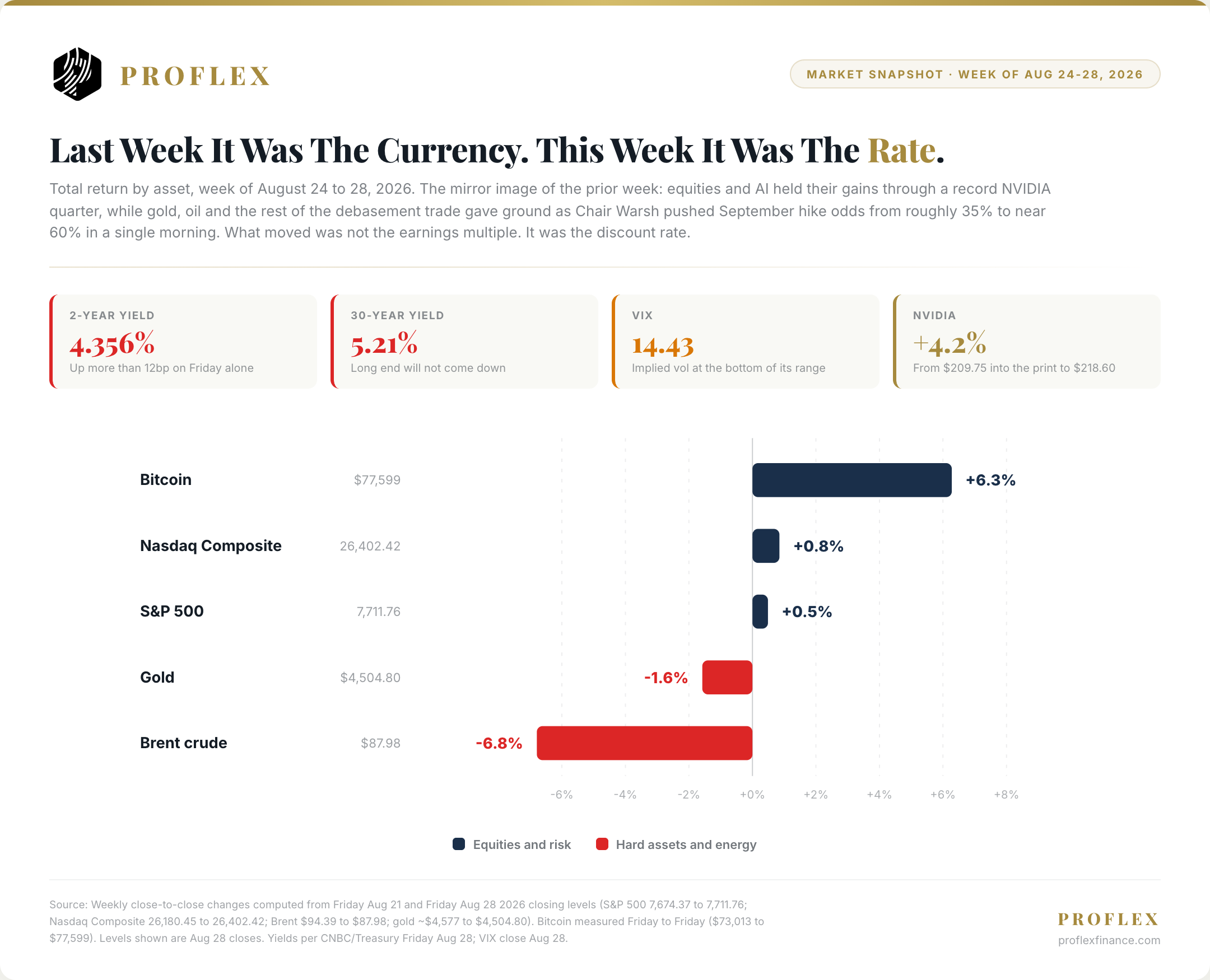
The tape absorbed both. The S&P 500 closed Friday at 7,711.76, down 0.25% on the day but up 0.5% on the week. The Nasdaq Composite gained 0.9%, the Dow 0.5% for its first winning week in three. What moved was not equities, it was the discount rate. The two year yield jumped more than 12 basis points Friday to 4.356%, the ten year to 4.72%, and the thirty year held 5.21%. Gold fell 3.4% to $4,504.80. Bitcoin fell 3.1% to $77,599. Brent, which we flagged at $94 and rising a week ago, gave the move back and sits near $88.
And the VIX closed the week at 14.43.
That last number is the one to sit with. The two largest scheduled events of the quarter are now resolved, September futures put a rate hike at roughly a coin flip, systematic positioning is near the top of its five year range, and three month implied volatility across the S&P, Nasdaq and Russell has collapsed to the very bottom of its six month distribution. The market has cleared its catalysts and priced almost no risk into what comes next.
The question this week is therefore not what NVIDIA proved or what Warsh meant. Both are settled. The question is what moves this market next, and the honest answer is that between Friday’s close and the September 16-17 FOMC there is almost nothing left except data. Which is why the August employment report on Friday has quietly become the most important number of the quarter.
Key Drivers This Week
NVIDIA Cleared The Bar, And This Time The Tape Paid For It
Two weeks ago we wrote in this letter that "NVIDIA on August 26 is the next proof point," and last week we said plainly that "the bar is a beat and a raise, and we expect NVIDIA to clear it." Here is what landed.
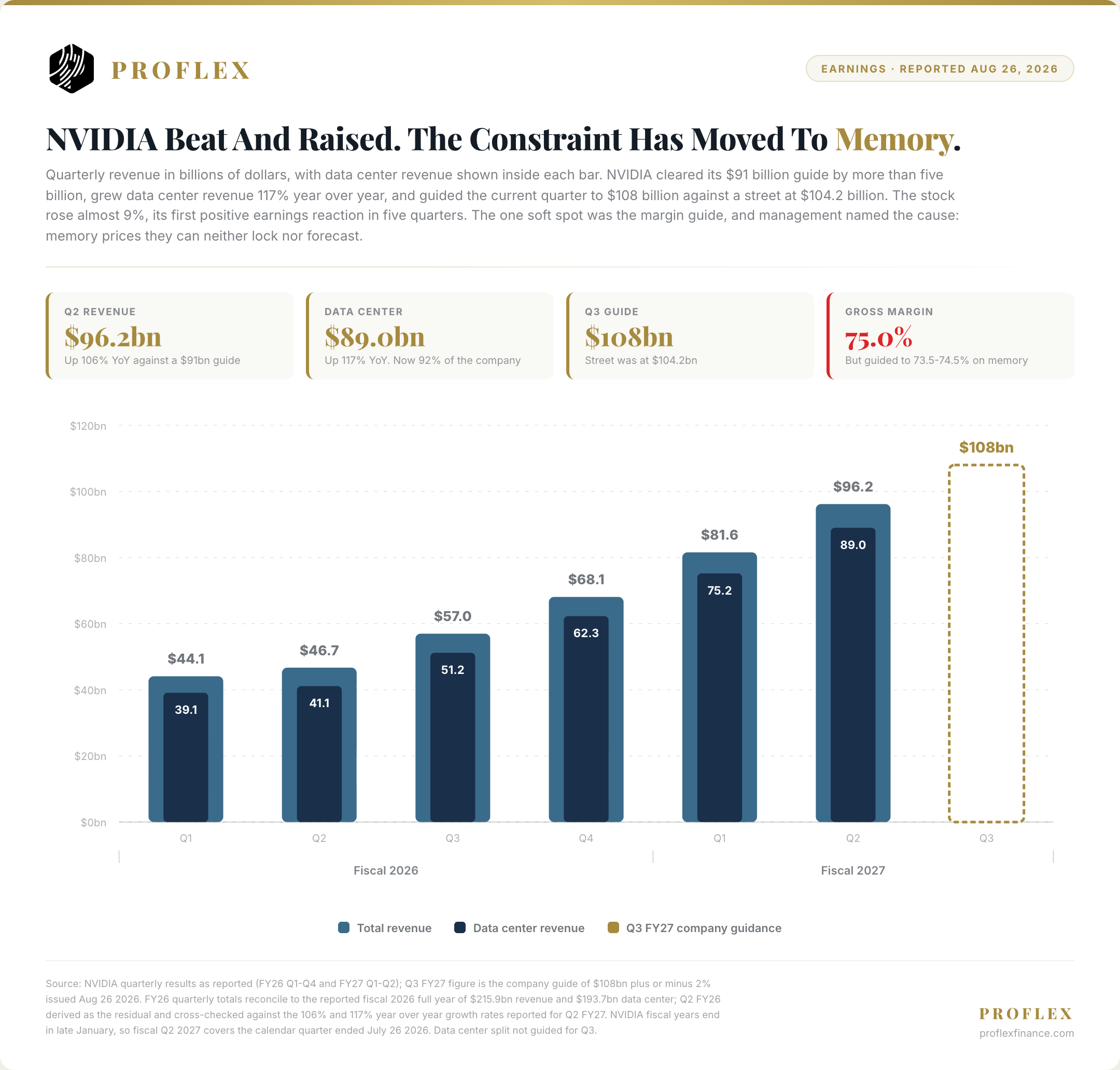
Revenue of $96.2 billion, up 106% year over year and 18% sequentially, against a company guide of $91 billion and consensus at $91.9 billion.
Data center revenue of $89.0 billion, up 117%, now 92% of the company.
Non GAAP EPS of $2.22 against $2.10 expected. GAAP and non GAAP gross margins both 75.0%, exactly the level we said was the test.
The guide: $108 billion for the current quarter, plus or minus 2%, against a street at $104.2 billion.
That is a beat and a raise of nearly four billion dollars on a number that is already the largest quarterly revenue any semiconductor company has ever guided to.
Then the stock did something it had not done in a year. It went up. Nearly 9%, from $209.75 into the print to a $222.79 high, settling at $218.60 by Friday after Warsh took some of it back. Four consecutive beats had been sold. The fifth was bought.
We got the print right and the margin test right. We got the reason wrong, and it is worth saying so. We wrote that what would change the tape was "gross margin held at 75% with an explicit statement that memory costs are contracted rather than floating." Margin held. The statement was the opposite of contracted, and the market bought it anyway.
Proflex View: The reaction function has flipped, and that matters more than the quarter. For four quarters the market treated an NVIDIA beat as a reason to take profits because the bar kept rising faster than the results. This time it treated a beat plus a $108 billion guide as confirmation that the demand curve is not the constraint. That is a healthier setup than the one we had in July, but it also means the easy repricing is done. From here NVIDIA is a supply chain story, not an earnings story.
The Memory Thesis, Confirmed By The Largest Buyer In The World
This is the most important thing that happened last week and almost nobody led with it.
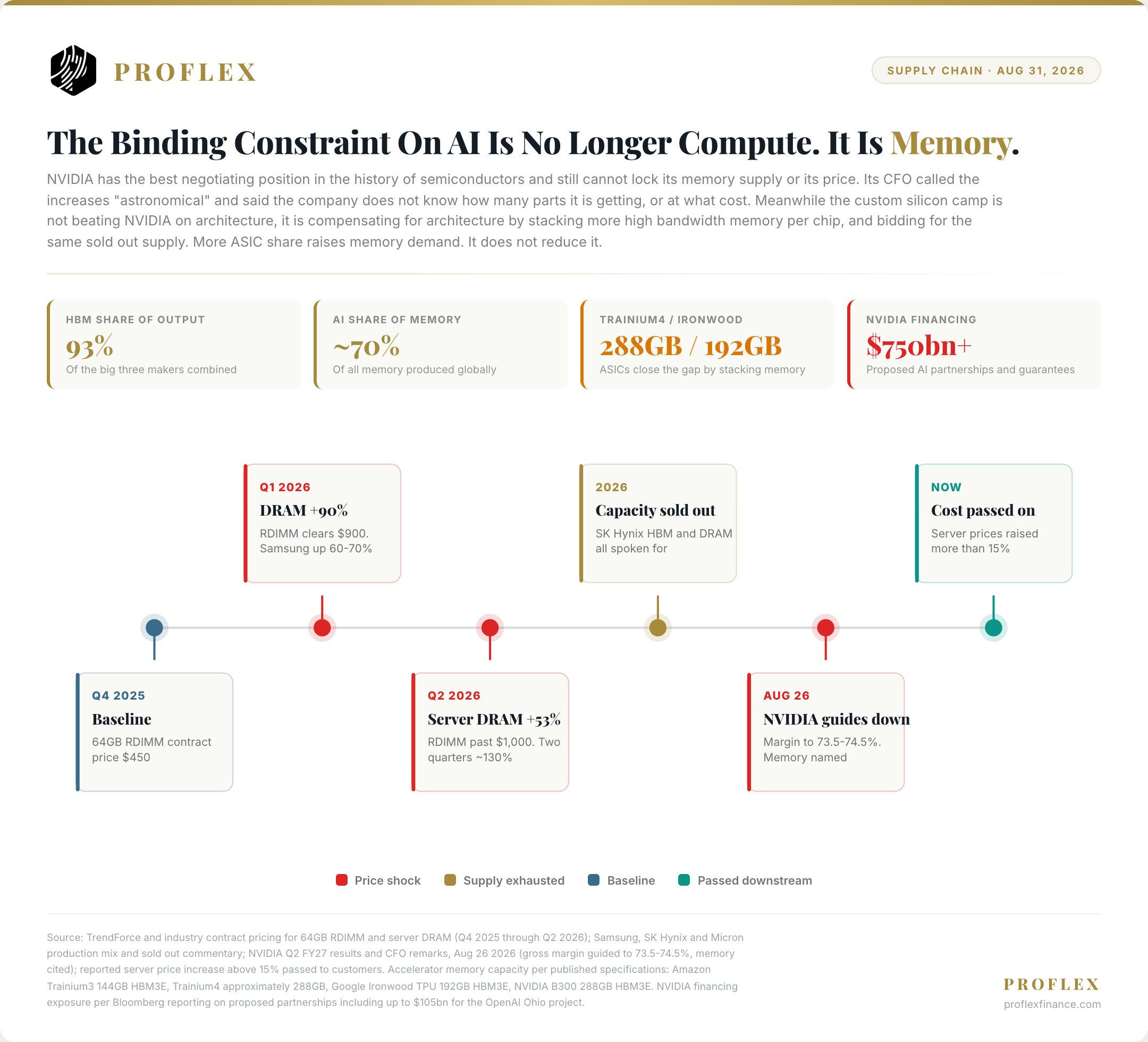
NVIDIA guided current quarter gross margin down to 73.5% to 74.5%, below street estimates, and named the reason: memory. CFO Colette Kress told Yahoo Finance minutes after the call that memory price increases are "astronomical," and then said the part that should be pinned to a wall: "you have secured, we call it capacity, but you actually don’t know how many you’re getting, and at what price." Jensen Huang said demand is growing beyond 70% and is constrained by supply, not by orders.
Read that again. The company with the best negotiating position in the history of semiconductors cannot lock its memory supply or its memory price. It has responded by notifying customers of a server price increase above 15%, passing the inflation straight downstream.
Now put that next to what is happening on the other side of the AI trade. The custom silicon camp is not beating NVIDIA on architecture. It is compensating for architecture by stacking memory. Amazon’s Trainium3 carries 144GB of HBM3E at 4.9 TB/s and Trainium4 is spec’d near 288GB with four times the bandwidth. Google’s Ironwood TPU carries 192GB at 7.37 TB/s. Meta has said its next generation MTIA will carry significantly more high bandwidth memory. Every one of those parts is cheaper than a Blackwell and every one of them closes the gap by bidding for the same finite HBM supply that NVIDIA is bidding for.
The supply side is already gone. Samsung, SK Hynix and Micron have shifted roughly 93% of combined production toward HBM. SK Hynix has said its HBM, DRAM and NAND capacity is essentially sold out for 2026. Micron exited consumer memory entirely. AI data centers now consume close to 70% of global memory output. Prices have moved accordingly: 64GB RDIMM contract pricing went from $450 in Q4 2025 to above $900 in Q1 and past $1,000 in Q2, with server DRAM up another 53% quarter on quarter and Samsung’s cumulative two quarter increase near 130%.
And NVIDIA is adding demand rather than rationing it. The company has committed up to $105 billion of financing to the OpenAI data center in Pike County, Ohio, is reported to be discussing guarantees as large as $250 billion on that project, put $10 billion into Anthropic, and by Bloomberg’s count sits inside proposed partnerships and financing arrangements worth more than $750 billion. Vendor financing does not create memory. It creates buyers of memory.
Proflex View: This is the cleanest supply and demand setup in the market and it is on the wrong side of the trade almost everyone is holding. More custom ASIC share does not reduce memory demand, it raises memory content per accelerator, because stacking memory is exactly how a cheaper chip compensates for a weaker architecture. NVIDIA’s own financing deals then add a second demand curve on top. We expect the memory names to keep beating and keep getting raised numbers every quarter for as long as this holds, and we would treat a rate driven selloff in Micron, of the kind we got Friday, as noise against a supply picture that is already sold out. The constraint is not orders. It is wafers.
Warsh Said "Work To Do". The Market Is Pricing The Wrong Question.
Free Weekly Insights
Get This Analysis Every Week
Join 250+ investors at Google, Amazon & Apple who start their week with Proflex.
No spam. Unsubscribe anytime.
Warsh’s first Jackson Hole keynote gave the market almost no guidance on September, which was the point. He wants a quieter Fed and said so: "a quieter Fed, more purposeful in its communications, is better able to meet its objectives," and forward guidance "risks creating ambiguity in the name of clarity." He warned about the hall of mirrors where "markets rely materially on the Fed’s guidance and the Fed relies on market prices."
But he was unambiguous on the target. Two percent on PCE is "a firm, fixed target." He accepted the blame directly: "the responsibility for 65 months of sustained, elevated inflation sits squarely with the central bank." He rejected the idea that this fixes itself: "price stability is not self executing, nor is inflation necessarily mean reverting." And then the line that repriced the curve: "we must be confident that underlying inflation is moving to our objective, clearly and at sufficient speed. Otherwise, we have work to do."
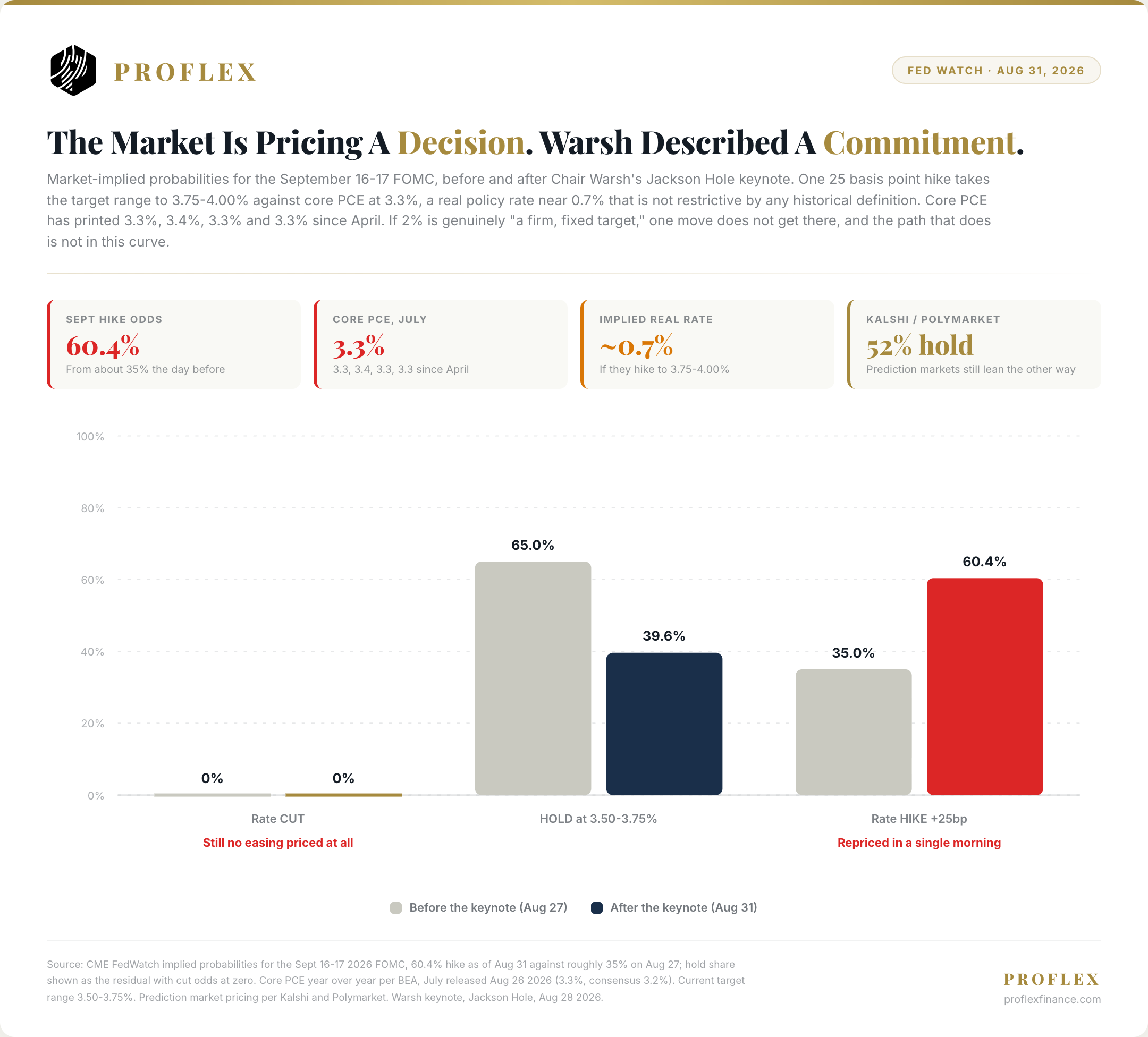
September hike odds went from roughly 35% the day before to near 60% on CME FedWatch. Polymarket and Kalshi still price a hold at 52%. Goldman’s Jan Hatzius is holding his call for no change through the remainder of 2026. Morgan Stanley’s Michael Gapen says inflation is decelerating and the Fed stays sidelined. JPMorgan’s wealth strategists have penciled in the 25 basis point increase. The street is genuinely split, and that alone tells you the September meeting is not the thing to solve for.
Here is our read. A single 25 basis point hike is not a problem. It takes the target range to 3.75% to 4.00% against core PCE that printed 3.3% in July. That is a real policy rate of about seventy basis points, which is not restrictive by any historical definition of the word. Markets can absorb that in an afternoon, and largely just did.
The problem is what the word "firm" implies. Core PCE has now printed 3.3%, 3.4%, 3.3% and 3.3% in April, May, June and July. Four months, no net progress, on the exact series he called a fixed target. If Warsh means what he said about 2%, one hike does not get you there. It gets you to barely positive real rates in an economy where the thirty year is already at 5.21% and long end auctions have been drawing weak demand since mid August. The path that actually delivers 2% is more than one move, and that path is not in the curve today.
Proflex View: The market is pricing a rate decision when it should be pricing a commitment. September is close to a coin flip and either outcome is survivable, but the distribution beyond September is the one that is mispriced: there is no scenario in the curve where recommitting to 2% requires a sequence rather than a gesture. Watch the long end, not the front end. If the thirty year pushes back through 5.25% while the two year is also rising, the market has stopped believing that one hike is the whole answer, and that is the version of this that costs equity multiples.
Positioning Is Full, Volatility Is Empty, And The Catalysts Are Gone
BofA’s systematic positioning work put global equity exposure near the top of its five year range this week, at roughly $490 billion, about $174 billion above the five year median near $316 billion. For the first time in a month, their model is biased to sell in every scenario:
A flat week now produces $1 billion of selling, down from $22 billion of buying the prior week.
An up week, defined as the 97.5th percentile path of about +3.5%, produces $9 billion of selling, down from $5 billion of buying.
A down week, the 2.5th percentile path of about -2.9%, produces $163 billion of selling, up from $114 billion last week and $96 billion the week before. CTAs are roughly $130 billion of that.
The first sell triggers sit about 2% below spot on the S&P, 4% on the Nasdaq and 1.4% on the Russell. The Russell fell 1.4% Friday. It is sitting on the trigger.
Overlay that with volatility. Three month at the money implied volatility on the S&P, Nasdaq and Russell ETFs has collapsed to roughly the zero percentile of its six month range, and the VIX closed at 14.43. So the market has simultaneously reached maximum length, minimum hedging cost and an empty catalyst calendar.
Tap into real-time commentary from Proflex experts on market shifts, policy cycles, and global events—alongside daily discussions from 190+ Silicon Valley CTOs, CEOs, family offices, and seasoned HNIs.
Proflex View: This is not a bearish signal, it is a fragility signal, and the distinction matters. Nothing in this configuration causes a selloff. It only determines what a selloff looks like once something else starts one, and the asymmetry is stark: $9 billion of mechanical selling if we rally, $163 billion if we drop 3%. With hedges this cheap, the sensible response is not to sell exposure, it is to own the convexity that the volatility market is currently giving away. We have argued for months that the corrections do not stick. That remains our base case. It is also exactly why buying protection at the zero percentile is cheap insurance rather than a change of view.
Jobs Week: The Calendar Becomes The Catalyst
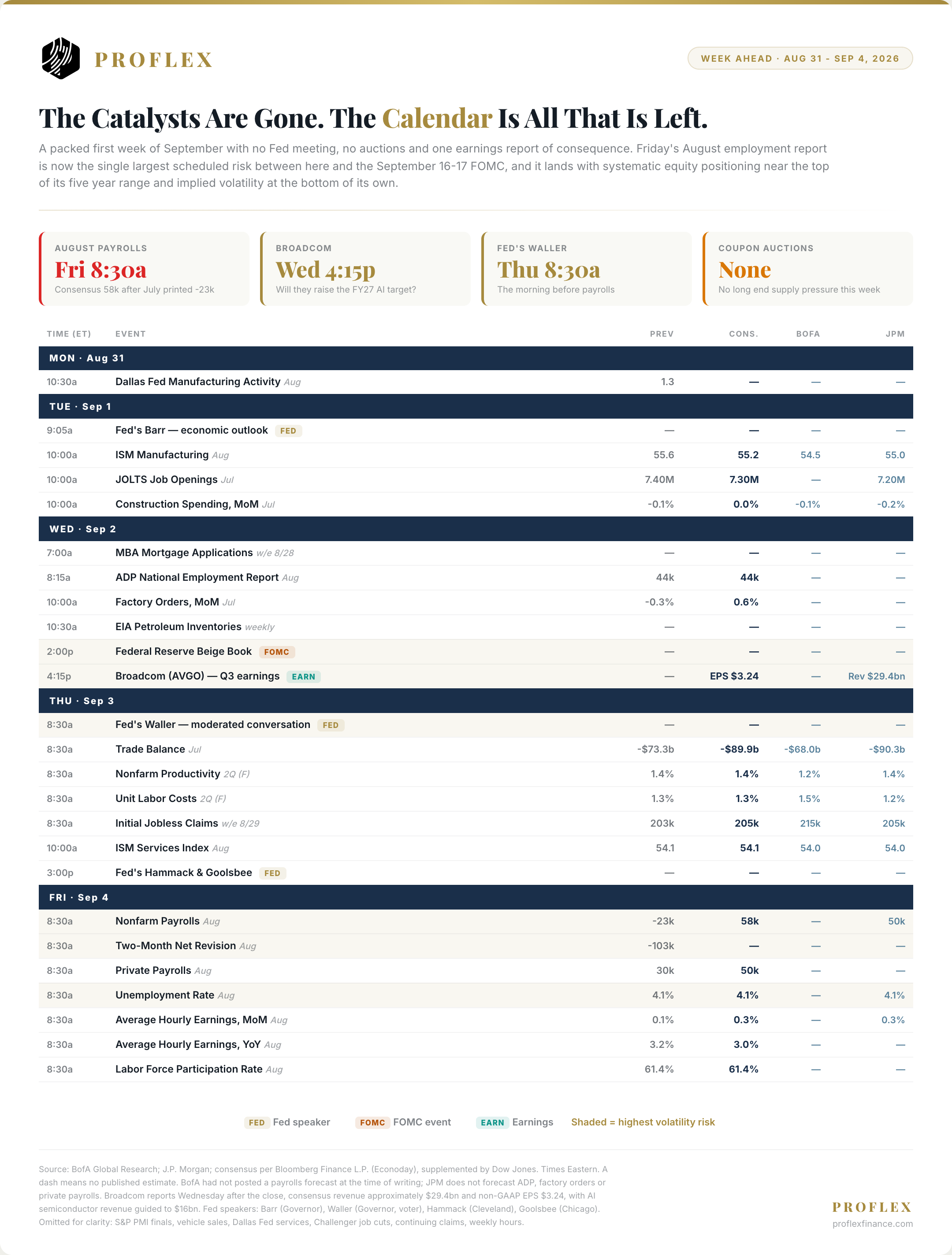
Anyone hoping for one last quiet pre Labor Day week is going to be disappointed. Tuesday starts September and the week ends with the August Employment Situation report.
Tuesday brings ISM Manufacturing for August, with consensus at 55.2 against 55.6 prior (BofA is below at 54.5), July JOLTS openings expected at 7.30 million from 7.40 million, and construction spending. Governor Barr speaks at 9:05am and has been hawkish lately, so expect something close to the Warsh line.
Wednesday is ADP at 44,000, factory orders, and the Beige Book at 2:00pm, which is the regional conditions survey that feeds directly into the September meeting. After the close, Broadcom reports fiscal Q3. Consensus is roughly $29.4 billion in revenue and $3.24 in non GAAP EPS against $1.69 a year ago, with AI semiconductor revenue guided to $16 billion, up more than 200%. The number that decides the reaction is not the quarter, it is whether management raises the fiscal 2027 AI target above $100 billion. Declining to raise it last quarter cost the stock 12.6% on an otherwise clean beat.
Thursday is the busiest day: Governor Waller in a moderated conversation at 8:30am, jobless claims expected near 205,000, trade balance, final Q2 productivity and unit labor costs, ISM Services at 54.1, and Hammack and Goolsbee at 3:00pm. Waller has been the most influential voice on this committee outside the Chair, and he speaks the morning before payrolls.
Friday, 8:30am is the whole week. August nonfarm payrolls are expected at 58,000 (JPMorgan is at 50,000) after July printed minus 23,000, with a two month net revision last time of minus 103,000. Unemployment is expected to hold at 4.1%, average hourly earnings at 0.3% month over month and 3.0% year over year, down from 3.2%.
Two footnotes worth carrying. First, the preliminary benchmark revision released Friday morning came in at minus 79,000 for March 2026, or 0.1%, against a ten year average absolute revision of about 0.2% and against last year’s minus 911,000. That was the tail risk we flagged before Jackson Hole and it did not bite. Second, there are no coupon auctions next week, which removes the one recurring pressure point that has been troubling the long end since mid August.
As we said now twelve weeks ago on Iran, we will just have to see how things progress. Brent has gone from $95 to $88 in a week and roughly six to eight million barrels a day are still moving through Hormuz without an agreement. Last week we flagged Brent at $94 as the first evidence against our own position. That evidence has receded, and we will keep marking it either way.
Proflex View: Friday is a two sided risk and the market is not positioned for either tail. A hot payroll number confirms Warsh and pushes September through a coin flip toward a done deal, which pressures the long end and the multiple. A second consecutive negative print undercuts the entire hawkish repricing in one release and puts the growth question back on the table. With systematic length at the top of its range and volatility at the bottom, respect 8:30am Friday as a standalone risk event and size into it rather than after it.
🔍 What We’re Watching
Friday’s payroll print against 58,000, and the two month revision underneath it
The thirty year at 5.21%. A push back through 5.25% says one hike is not the answer
Broadcom’s fiscal 2027 AI target on Wednesday. Raise it or repeat the 12.6% lesson
Russell 2000, sitting 1.4% above BofA’s first systematic sell trigger
Memory contract pricing into Q4. Sold out capacity plus NVIDIA financing new buyers
🧭 Proflex Playbook – Respect the Calendar, Not the Narrative Two scheduled events on Wednesday afternoon and Friday morning carry more risk than anything the tape did last week. The liquidity story running underneath them, from the Treasury rather than the Fed, is the one almost nobody is pricing. Our conviction stays anchored in the data:
Focus on Structural Growth: Continue to overweight the secular AI theme, recognizing its multi-year runway.
Anticipate Shallow Corrections: Use dips as accumulation opportunities, not reasons for fear, understanding that "none of the corrections stick."
Diversify Thoughtfully: Recognize the "decorrelation" across asset classes; consider gold, silver and Bitcoin for portfolio resilience.
Develop Mental Models: Prioritize long-term planning (6-12 months out) over short-term news, aiming for consistent, incremental gains.
If you're an All-Access or Managed Portfolio subscriber, our positioning has already shifted ahead of this moment—scaling up asymmetric hard asset plays while hedging for earnings volatility and geopolitical tail risks.
Proflex All-Access: Your Market Compass
Explore the financial markets with Proflex All-Access, your comprehensive resource for deeper market understanding and active participation. This premium service offers subscribers exclusive insights and actionable investment advice, giving you a significant edge in various market conditions.
Proflex All-Access provides detailed analyses and recommendations to optimize your investment strategy. Our specialized newsletters include:
• Growth Gazette (Contains Crypto Pulse) : Aimed at achieving above-market returns for aggressive portfolio growth.
• Income Insider: Focused on conservative strategies and income generation for yield-seeking investors.
Until next week, — The Proflex Team Trusted Macro Insights. Calm Investing. Tactical Trades.
Elevate your financial IQ
ProFlex® by Proflex Finance Legal Disclosures
ProFlex® by Proflex Finance, the premium newsletter product series, provides informational and educational content only and does not offer personalized investment advice or establish a fiduciary relationship. While we rely on reliable sources and research, the information is not tailored to individual financial situations. Readers are urged to consult qualified financial professionals before making investment decisions. We do not guarantee the accuracy, completeness, or timeliness of the information and are not responsible for any investment decisions based on this newsletter. Investing carries risks, and past performance doesn't predict future results. By accessing this newsletter, you acknowledge that we are not liable for actions or decisions resulting from its content. Please conduct due diligence and seek professional advice as needed.
Frequently Asked Questions
The Fed targets 2% inflation measured by the PCE index. When CPI or PCE readings come in above target, the Fed may maintain or raise rates to cool the economy. Below-target readings give the Fed room to cut rates. Markets watch these releases closely because they signal the direction of monetary policy.
Earnings reports reveal actual business performance versus market expectations. Revenue growth, profit margins, and forward guidance drive stock re-ratings. Beats or misses relative to consensus estimates move individual stocks and can shift sector-wide sentiment. Earnings season also provides insight into broader economic health and consumer spending trends.
Sector rotation signals include divergence between growth and value indices, relative strength shifts in sector ETFs, credit spread movements, and changes in the yield curve. When defensive sectors outperform cyclicals, it often signals risk-off positioning. Monitoring small-cap (Russell 2000) relative to large-cap performance provides insight into economic confidence and risk appetite.
Federal Reserve rate decisions directly influence borrowing costs, corporate earnings, and investor sentiment. Rate cuts typically boost equities by lowering discount rates and encouraging risk-taking, while rate hikes can compress valuations. The market often prices in expected moves weeks in advance, so the surprise element and forward guidance matter more than the decision itself.
Massive capital expenditure on AI infrastructure (data centers, GPUs, networking) is creating a new investment super-cycle. Companies like NVIDIA benefit directly from hardware demand, while hyperscalers (Microsoft, Google, Amazon) invest billions in AI capabilities. This spending flows through to semiconductor suppliers, power utilities, and cooling technology companies, creating multi-layered investment opportunities.